
August 31, 1735 - John Sergeant Ordained
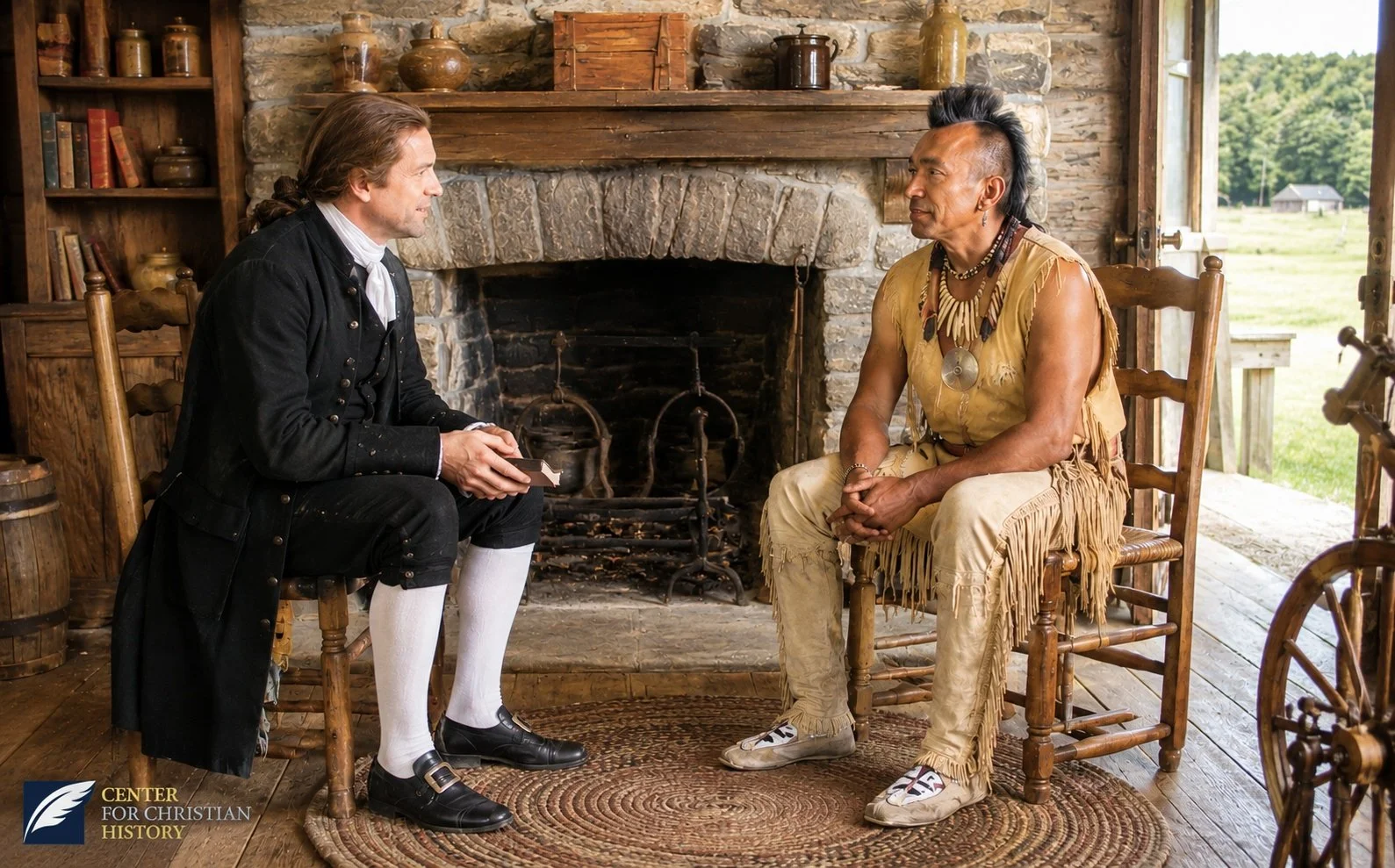
AI-generated historical reconstruction of Rev. John Sergeant meeting with Mahican leader Konkapot at the Stockbridge mission, c. 1735–1740. Created for the Center for Christian History using ChatGPT (OpenAI), July 2026, based on the composition of an illustration by Dean Cornwell, The Missionary John Sergeant Meets Chief Konkapot, in Francis Parkman, Montcalm and Wolfe (Boston: Little, Brown & Co., 1884), Public Domain. Used for educational purposes.
One missionary whose work shaped both Native American and colonial history was John Sergeant. Ordained on August 31, 1735, Sergeant dedicated his ministry to the Mahican people of western Massachusetts and the Hudson River Valley. Rather than serving established English congregations, he lived among the Mahicans, learned about their culture, and sought to share Christianity through preaching, education, and Bible instruction.
During this period, the Mahican leader Konkapot recognized that continued military resistance against expanding European settlement was unlikely to succeed. He pursued peaceful relations with the colonists and eventually expressed interest in Christianity. Under Sergeant's ministry, Konkapot was baptized, and many other Mahicans also embraced the Christian faith. Sergeant helped establish the mission community at Stockbridge, where converts received religious instruction while the community also became a center for education and interaction between Native Americans and English settlers.
Why It Matters
John Sergeant's ministry illustrates one of the many ways Christianity spread in colonial North America through cross-cultural missions. His work also highlights the complex relationship between evangelism, Native American communities, and European expansion. While some Indigenous leaders viewed Christianity as a sincere religious conviction, others also saw alliances with missionaries as a practical means of navigating profound political and cultural changes. The history of the Stockbridge mission reflects both genuine religious conversions and the broader challenges faced by Native peoples during the colonial era.