
September 16, 1498 - Tomás de Torquemada
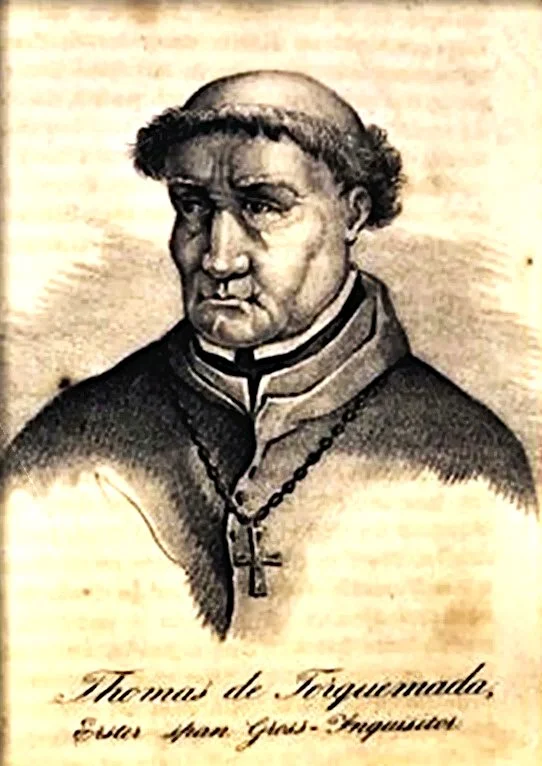
Tomás de Torquemada, Inquisitor General of Spain. Anonymous portrait, date unknown. Public domain. Via Wikimedia Commons.
Few names have become as closely associated with religious persecution as Tomás de Torquemada, the Dominican friar who became the first Inquisitor General of the Spanish Inquisition. Torquemada died at Ávila on September 16, 1498, after helping construct an institution that would continue operating in various forms for more than three centuries.
The Spanish Inquisition emerged from the complicated religious world of late medieval Spain. For centuries, the Iberian Peninsula had contained substantial communities of Christians, Jews, and Muslims. During the fourteenth and fifteenth centuries, however, violence and increasing pressure against Jewish communities led many Jews to accept baptism. These converts and their descendants became known as conversos, or “New Christians.”
Conversion did not necessarily end hostility toward them. Some Christians suspected that conversos continued practicing Judaism privately while outwardly professing Christianity. The accuracy of these accusations varied considerably, and modern historians emphasize that conversos cannot be treated as a single religious group. Some became committed Christians; others retained elements of Jewish practice or identity; still others occupied complicated positions between the two.
Against this background, Ferdinand of Aragon and Isabella of Castile sought authorization from Pope Sixtus IV for an inquisition under royal control. In 1478, the pope permitted the monarchs to appoint inquisitors. The first tribunals began operating shortly afterward, initially concentrating heavily upon conversos suspected of “Judaizing.”
This distinction is important. The Inquisition was principally a tribunal for investigating baptized Christians accused of heresy. Jews who remained openly Jewish were not initially under its ordinary jurisdiction because they had never professed Christianity. The situation changed dramatically in 1492, when Ferdinand and Isabella ordered Jews in their kingdoms either to accept Christianity or leave. The resulting conversions created another population of New Christians whose religious practices could subsequently come under inquisitorial scrutiny.
Torquemada became the dominant figure in the institution’s early development. A Dominican friar who had served as a confessor and adviser to Isabella, he was appointed Inquisitor General in the 1480s. Under his leadership, procedures were standardized and tribunals expanded. Investigations could involve secret testimony, imprisonment, confiscation of property, public penances, and, in some cases, torture. Those convicted of serious heresy who refused to repent or who relapsed could ultimately be handed over to secular authorities for execution, frequently by burning.
Even contemporaries raised objections to inquisitorial abuses. Pope Sixtus IV complained about unjust imprisonment, torture, and condemnation during the Inquisition’s early years and attempted to restrain some of its practices. Yet Ferdinand and Isabella strongly defended royal authority over the institution. The result was an unusual arrangement: although the Inquisition was explicitly Catholic in its purpose and staffed heavily by clergy, the Spanish Inquisition was also an instrument of the monarchy and enjoyed substantial independence from direct papal administration.
Torquemada also became associated with the campaign that culminated in the 1492 expulsion of Spain’s Jews. Historians debate precisely how much personal influence he exercised over Ferdinand and Isabella’s decision, but he strongly supported religious uniformity and the removal of Jewish influence that inquisitors believed encouraged conversos to retain Jewish practices.
The number of people executed during Torquemada’s tenure has long been disputed. Older accounts often attributed approximately 2,000 executions to his period as Inquisitor General, while some earlier polemical histories produced vastly larger figures. Modern scholarship has substantially revised many traditional estimates of the Inquisition’s victims and cautions against treating precise totals from early accounts as settled fact. What is beyond dispute is that executions occurred, torture was employed, property was confiscated, families were stigmatized, and fear of investigation became an important feature of Spanish religious life.
The Inquisition also reflected a larger late-medieval and early-modern assumption that religious unity and political stability were closely connected. Heresy was not generally understood simply as a private disagreement about theology. Christian governments could regard religious dissent as a danger to both church and society. That context helps explain why inquisitorial institutions existed, but it does not erase the human consequences of coercion carried out in defense of religious conformity.
Torquemada died on September 16, 1498, but the institution he helped organize survived him. Its targets changed over succeeding generations, eventually including suspected Protestants, Muslims who had converted to Christianity, and Catholics accused of various religious offenses. The Spanish Inquisition was finally abolished in the nineteenth century.
Why It Matters
Torquemada's career illustrates the close relationship between religious authority and royal power in late fifteenth-century Spain. The Inquisition's treatment of conversos, its use of coercive judicial procedures, and its role in enforcing Catholic uniformity profoundly affected Spain's Jewish and Christian communities and helped shape the religious character of the emerging Spanish monarchy. Its history also became central to later debates over religious persecution, toleration, and the appropriate relationship between church and state.
