
August 5, 642 - King Oswald of Northumbria Killed in Battle
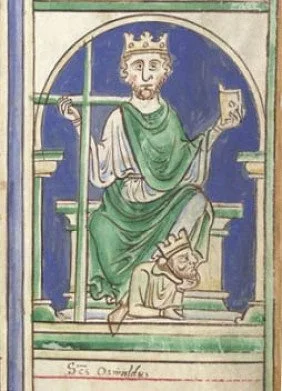
King Oswald of Northumbria, medieval manuscript illumination from Matthew Paris, Chronica Majora, c. 1250–1259. Parker Library, Corpus Christi College, Cambridge. Public domain.
King Oswald of Northumbria is remembered not only as a successful ruler but also as one of the earliest Christian kings to help establish the faith in northern England. After spending part of his youth in exile at the monastery on the island of Iona, Oswald was deeply influenced by the Irish monk Columba and the Christian community founded there. Although Columba had died decades earlier, his ministry and the monastery at Iona continued to shape generations of missionaries and leaders, including Oswald.
When Oswald regained the throne of Northumbria in 634, he made Christianity a central part of his reign. Rather than imposing the faith by force, he invited missionaries from Iona to evangelize his kingdom. The most famous of these was Aidan, who established the monastery at Lindisfarne. Oswald often served as Aidan's translator, helping communicate the gospel to his people and supporting the spread of Christianity throughout the region.
Oswald's commitment to Christ extended beyond church building and missionary work. He sought to govern according to Christian principles and became known for his generosity toward the poor and his support of the Church. His reign helped lay the foundation for the eventual Christianization of much of Anglo-Saxon England.
On August 5, 642, Oswald was killed at the Battle of Maserfield while defending his kingdom against the pagan king Penda of Mercia. Medieval tradition records that he prayed for his soldiers as he died, and he was soon honored as both a martyr and a saint. His death did not end his influence; instead, his example inspired generations of Christians across Britain, and devotion to him spread throughout medieval Europe.
Why it matters:
King Oswald demonstrates how a leader's personal faith can shape an entire nation. By supporting missionaries, encouraging biblical teaching, and using his influence to strengthen the Church, he played a pivotal role in the spread of Christianity in early medieval England. His life reminds us that faithful leadership can leave a spiritual legacy that endures long after a person's death.