
September 2, 1973 - J.R.R. Tolkien Dies
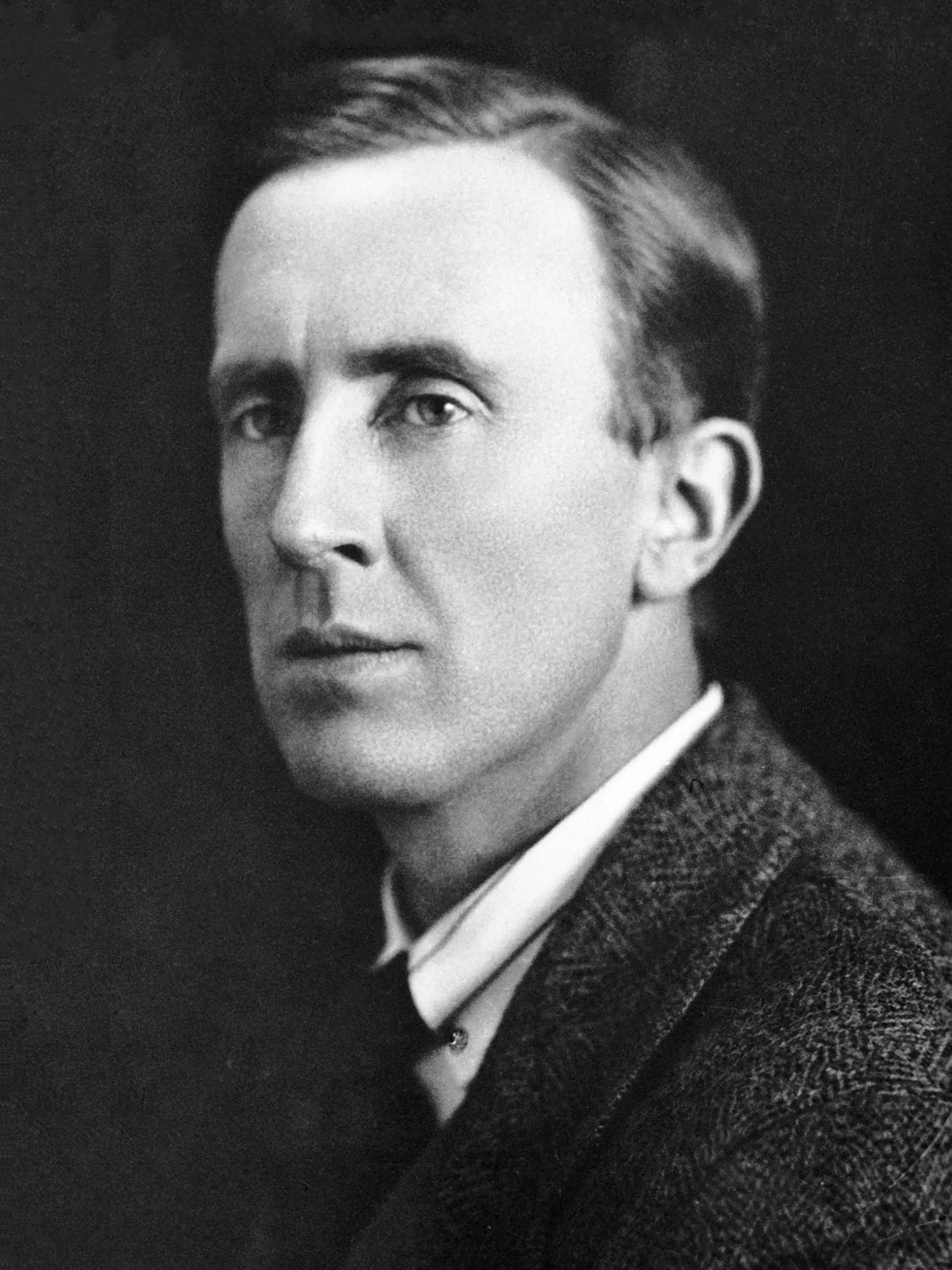
J.R.R. Tolkien, c. 1925. Photograph by an unknown studio. Public domain. Courtesy of Wikimedia Commons.
On September 2, 1973, J.R.R. Tolkien died at the age of eighty-one while visiting friends in Bournemouth, England. By then, the Oxford professor and philologist had become one of the most influential fantasy writers of the twentieth century. The Hobbit and The Lord of the Rings had introduced millions of readers to Middle-earth, yet the religious convictions of the man who created that world were considerably less obvious. Tolkien was a devout Roman Catholic, and although Christianity rarely appears explicitly in his best-known fiction, he acknowledged that his faith profoundly shaped the stories he told.
John Ronald Reuel Tolkien was born on January 3, 1892, in Bloemfontein, in what was then the Orange Free State in southern Africa. His father died when Tolkien was four, and his mother, Mabel, remained in England with Tolkien and his younger brother, Hilary. In 1900, Mabel converted to Roman Catholicism despite opposition from members of her family. Her sons were raised in the Catholic faith, and after her death in 1904, the Catholic priest Francis Morgan became their guardian.
Catholicism remained an important part of Tolkien's identity throughout his life. His religious commitment was not merely a private affiliation detached from his intellectual and literary work. Tolkien later credited the faith in which he had been raised with shaping his understanding of the world, morality, creation, death, and hope. Those convictions eventually became woven into his imaginative literature.
Tolkien's professional life, however, was centered on language and literature. After studying at Oxford and serving in the British Army during World War I, he became a distinguished scholar of Old and Middle English. He eventually became Professor of Anglo-Saxon at Oxford and later Professor of English Language and Literature at Merton College. His fascination with ancient languages, myths, and legends contributed directly to his creation of Middle-earth. Tolkien did not simply invent stories and then supply his characters with fictional languages; his invented languages and mythology developed together over many years.
In 1937, Tolkien published The Hobbit, originally conceived primarily as a children's story. Its success led his publisher to request a sequel. The project expanded enormously, ultimately becoming The Lord of the Rings, published in three volumes in 1954 and 1955. The story incorporated material from the much larger mythology Tolkien had been constructing for decades.
During these years Tolkien belonged to the Inklings, an informal group of writers and scholars who gathered in Oxford to read and discuss their work. Its best-known member besides Tolkien was his close friend C.S. Lewis. Tolkien played an important role in Lewis's movement toward Christianity, particularly during a famous 1931 conversation involving Tolkien, Lewis, and Hugo Dyson about Christianity, mythology, and the meaning of Christ's death and resurrection.
Yet Tolkien and Lewis approached Christianity in imaginative literature differently. Lewis's Chronicles of Narnia contains readily recognizable Christian parallels, particularly the lion Aslan, whose death and return to life deliberately evokes the story of Christ. Tolkien generally resisted that kind of direct correspondence. He famously disliked allegory and did not want readers reducing The Lord of the Rings to a code in which each character or event represented a specific Christian person, doctrine, or historical event.
That distinction is important when interpreting supposedly Christian elements of Middle-earth. Gandalf, for example, dies fighting the Balrog and later returns transformed as Gandalf the White. Christian readers may reasonably recognize similarities to death and resurrection, but Tolkien did not construct Gandalf as a simple allegorical representation of Jesus. Similar caution applies to attempts to identify Frodo, Aragorn, Sauron, or the One Ring with single biblical counterparts.
Tolkien nevertheless explicitly connected his faith with his fiction. In correspondence written while The Lord of the Rings was approaching publication, he described the work as “fundamentally religious and Catholic.” Significantly, Tolkien explained that this was one reason he had removed most explicit references to religious institutions and practices from the imaginary world. Rather than constructing churches, formal worship, or obvious Christian symbols throughout Middle-earth, he believed the religious dimension had been absorbed into the story itself.
That approach helps explain why Christian themes can be present without The Lord of the Rings functioning as Christian allegory. Providence, temptation, mercy, sacrifice, death, hope, moral responsibility, and the corrupting effects of the desire for power repeatedly shape the narrative. Characters make meaningful choices, but events also suggest that forces beyond their understanding may be at work. Tolkien could therefore write a story profoundly influenced by Christianity without turning Middle-earth into a disguised version of the Bible.
His friendship with Lewis illustrates another dimension of Tolkien's place in modern Christian history. Their relationship involved literature, language, mythology, and theology, and each encouraged the other's work. Lewis became the more explicit Christian apologist, while Tolkien produced imaginative literature whose religious foundations were intentionally less visible. Together, their work helped demonstrate two markedly different ways Christian convictions could interact with twentieth-century fantasy literature.
Tolkien's final years brought enormous international recognition. His wife, Edith, died in 1971 after fifty-five years of marriage. Tolkien returned to Oxford, but he never completed The Silmarillion, the larger mythology behind Middle-earth. After his death on September 2, 1973, his son Christopher edited and published The Silmarillion and numerous other writings. Tolkien was buried beside Edith in Oxford, their gravestone also bearing the names “Beren” and “Lúthien,” the lovers from Tolkien's mythology whose story had long held special meaning for the couple.
Why It Matters
Tolkien became one of the central figures in the development of modern fantasy literature, while his Catholic faith supplied an important intellectual and moral framework for his imaginative world. His approach differed significantly from the more explicit Christian symbolism of C.S. Lewis, demonstrating how Christian ideas could influence literature without appearing as direct allegory. The continuing study of Tolkien's faith has consequently become an important part of understanding both his literary achievement and the broader relationship between Christianity and twentieth-century popular culture.