
September 3, 1905 - Sundar Singh the Christian Sadhu of India Baptized
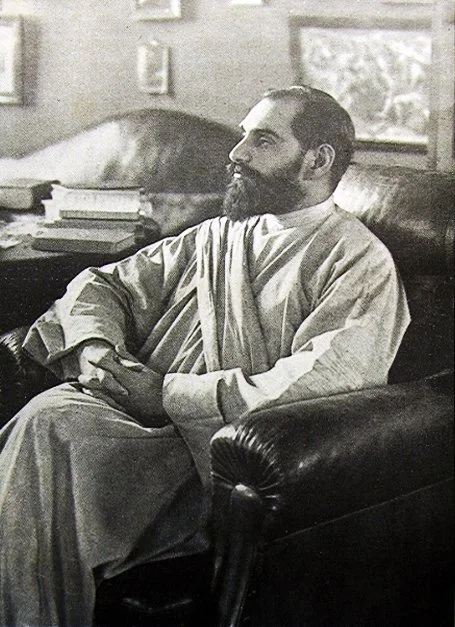
Sadhu Sundar Singh, c. 1922. Contemporary photograph, reproduced in Friedrich Heiler, Sadhu Sundar Singh: Ein Apostel des Ostens und Westens (Munich, 1924). Public domain, via Wikimedia Commons.
On September 3, 1905, his sixteenth birthday, Sundar Singh was baptized as a Christian in Simla, in northern India. The baptism marked the public culmination of a remarkable conversion that had already cost the young Sikh his place within his family. In the decades that followed, Sundar would become known internationally as “Sadhu Sundar Singh,” combining the traditional appearance and lifestyle of an Indian holy man with an explicitly Christian message.
Sundar Singh was born on September 3, 1889, in Punjab in northern India. He grew up in a prosperous Sikh family and was exposed from childhood to the religious traditions of India. His mother, to whom he was especially close, encouraged his religious interests and introduced him to the Indian tradition of the sadhu—a wandering ascetic who renounced ordinary comforts in pursuit of spiritual truth. Christianity entered his life through a Presbyterian mission school, but initially Sundar strongly rejected it.
The death of his mother while Sundar was still young contributed to a period of intense religious searching. His opposition to Christianity became so strong that he publicly burned a copy of one of the Gospels. Yet his hostility existed alongside a growing spiritual crisis. He studied Indian religious traditions but later said that he remained unable to find the peace and certainty he was seeking.
According to Sundar's own account, the decisive change came after he resolved to pray for God to reveal himself. If no answer came, he intended to end his life by placing himself before an approaching train. During the early morning hours, Sundar said, his room filled with light and he experienced a vision of Jesus Christ. He interpreted the experience as an encounter with the risen Christ and thereafter professed Christianity. Accounts differ over whether this occurred in December 1903 or December 1904, so the precise date remains uncertain even though the vision became central to Sundar's own explanation of his conversion.
His decision produced serious consequences. In colonial India, Christianity was frequently associated with European missionaries and British culture, making conversion more than a private religious decision. Sundar's family opposed his new faith, and he eventually cut his long hair, an important marker of Sikh identity. His father expelled him from the family home. Some biographies also recount that Sundar was poisoned shortly before leaving, although details of that episode depend largely upon later biographical accounts and should be treated cautiously.
Because of his age, Sundar had to wait before receiving baptism. On September 3, 1905, he was baptized in Simla. He soon made another decision that shaped the rest of his life. Rather than adopting the dress and cultural practices commonly associated with European missionaries, Sundar put on the saffron-colored robe of a sadhu. He began traveling with few possessions, relying upon hospitality while preaching from village to village.
The choice carried significance beyond clothing. Christianity had existed in India for many centuries, but the missionary expansion of the colonial era had strengthened public associations between Christianity and Western culture. Sundar presented a different model. His appearance, itinerant lifestyle, and manner of teaching were recognizably Indian, while the content of his preaching centered on Christ.
Sundar briefly pursued formal theological training at St. John's Divinity College in Lahore beginning in 1909, but institutional and denominational structures did not fit the independent ministry he preferred. Although baptized within the Anglican tradition, he did not make denominational identity central to his work. He instead continued traveling throughout India and repeatedly ventured into the Himalayan region and Tibet, journeys that later became an important part of his reputation.
By the late 1910s and early 1920s, Sundar's reputation had spread far beyond India. He traveled elsewhere in Asia and then visited Europe, North America, Australia, and the Middle East. Western Christians were fascinated by an Indian convert who looked nothing like the conventional European missionary. His visits attracted large audiences, while books and articles about him made him an internationally recognized Christian figure.
Sundar also became known for a strongly mystical understanding of Christianity. He described visions and ecstatic religious experiences and published several works presenting Christian teaching through dialogues and imagery familiar to Indian readers. His At the Master's Feet, originally published in Urdu and later translated into English, became one of his best-known works.
His fame also produced controversy. Some stories concerning his experiences, particularly accounts of miraculous events and certain journeys, were questioned even during his lifetime. Separating documented events from the devotional traditions that accumulated around him can therefore be difficult. His prominence as an Indian Christian leader, however, is well established.
Poor health increasingly restricted Sundar's travels during the 1920s. In 1929 he again set out toward Tibet and disappeared. His ultimate fate was never established, leaving the circumstances and exact date of his death unknown.
Why It Matters
Sundar Singh became one of the most internationally recognized Indian Christians of the early twentieth century and an important example of Christianity expressed through indigenous cultural forms. His ministry challenged the close identification of Christianity with Western culture in colonial India and contributed to broader discussions about how Christian faith could take distinctive forms within non-Western societies. His international popularity also made him an influential figure in Western Christian perceptions of Indian Christianity during the early twentieth century.