
September 5, 1651 - Obadiah Holmes Publicly Beaten in Boston
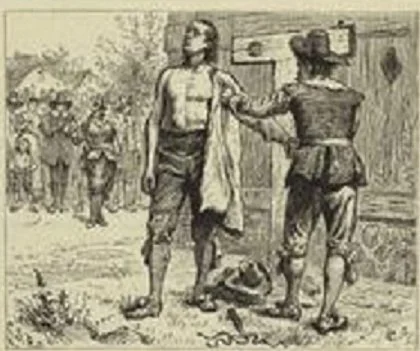
Obadiah Holmes before his public whipping in Boston, September 1651. Engraving, 1881. New York Public Library. Public domain.
The public whipping of Obadiah Holmes in Boston on September 5, 1651, became one of the most notorious examples of religious persecution in colonial New England. Holmes received thirty lashes with a three-corded whip after refusing to pay a fine imposed for his Baptist activities. His punishment exposed a fundamental conflict developing in the English colonies: whether civil governments possessed the authority to enforce religious conformity or whether individuals and churches should be free to follow their own convictions.
Holmes was born in England around 1607 and immigrated with his family to Massachusetts during the great migration of English Puritans to New England. He initially belonged to the Congregational church at Salem before moving to Rehoboth, then part of Plymouth Colony. There he became involved in disagreements over church government and baptism. By the late 1640s, Holmes and several others had embraced Baptist teachings, particularly the belief that baptism should follow a personal profession of faith rather than be administered to infants.
These convictions placed Holmes outside the religious establishment of colonial Massachusetts. Although the various New England colonies differed in their laws and practices, Massachusetts Bay in particular enforced religious conformity and enacted legislation against Baptists, often called “Anabaptists” by their opponents. Puritan leaders did not generally understand religious liberty as Americans later would. Many believed that maintaining a properly ordered Christian commonwealth required civil authorities to suppress religious teachings they considered dangerous to both church and society.
Rhode Island developed along a markedly different path. Founded largely through the efforts of religious dissenters such as Roger Williams, the colony became known for allowing considerably greater liberty of conscience. Holmes eventually relocated to Newport and became associated with John Clarke, an important Baptist minister, physician, and advocate for religious freedom.
In July 1651, Holmes accompanied Clarke and John Crandall from Rhode Island into Massachusetts Bay to visit William Witter, an elderly and nearly blind Baptist living at Lynn. Because Witter was unable to travel to Newport, the three men visited him at his home. While Clarke was conducting a religious meeting there, local authorities intervened and arrested the visitors.
The men were taken to Boston and prosecuted for their religious activities. The charges reflected more than simply their presence at an unauthorized meeting. Massachusetts authorities regarded their Baptist practices—including their rejection of infant baptism and their willingness to baptize people who had already received baptism as infants—as a direct challenge to the established churches.
Clarke was fined £20, Crandall £5, and Holmes £30, with corporal punishment prescribed if the fines were not paid. Friends arranged payment for Clarke, but Holmes refused to permit anyone to pay his fine. He believed doing so would amount to acknowledging that he had committed an offense.
Consequently, on September 5, Holmes was brought from prison to a public whipping post in Boston. There he was stripped to the waist and given thirty lashes. Holmes later described the punishment in a letter, and accounts of the event emphasized its severity. According to later testimony, his back was so badly injured that for some time afterward he could not comfortably lie upon it.
Holmes nevertheless remained defiant. After the whipping, he famously told the magistrates that they had struck him “as with roses.” The statement became part of Baptist historical memory, symbolizing his refusal to allow physical punishment to force him to abandon his convictions.
The authorities also punished people who publicly expressed sympathy toward him. Holmes later returned to Rhode Island, where he became a leading figure in the Baptist community at Newport. When John Clarke traveled to England, Holmes assumed greater responsibility for the Newport congregation and served it for decades.
The episode also became important far beyond Holmes himself. Clarke traveled to England and in 1652 published Ill Newes from New-England, an extensive attack on religious persecution in Massachusetts. His account included the prosecution of Holmes, Crandall, and himself and argued that civil authorities should not compel religious belief. The punishment intended to suppress Baptist activity therefore became evidence used by Baptists and other advocates of liberty of conscience against religious coercion.
The controversy unfolded during a larger seventeenth-century debate over the relationship between church and state. Rhode Island emerged as an important colonial experiment in religious toleration, and Clarke later played a central role in obtaining Rhode Island's royal charter of 1663. That charter contained unusually strong protections for liberty of conscience and allowed Rhode Island's religious experiment to continue.
Holmes died in 1682 after spending much of his later life in Newport. By then Baptists remained a religious minority in New England, but they had established permanent congregations despite opposition. Over the following century, Baptists would become increasingly influential in American arguments against government-established religion.
Why It Matters
The whipping of Obadiah Holmes illustrates that religious freedom was neither universally accepted nor consistently practiced in early colonial America. His punishment became part of the seventeenth-century controversy over whether governments could enforce religious conformity, while John Clarke used the episode in his broader campaign for liberty of conscience. The experience of Baptists in Massachusetts and Rhode Island became part of the longer American history that eventually produced stronger legal protections for religious exercise and opposition to established churches.