
September 6, 1529 - George Blaurock and the Birth of the Anabaptist Movement
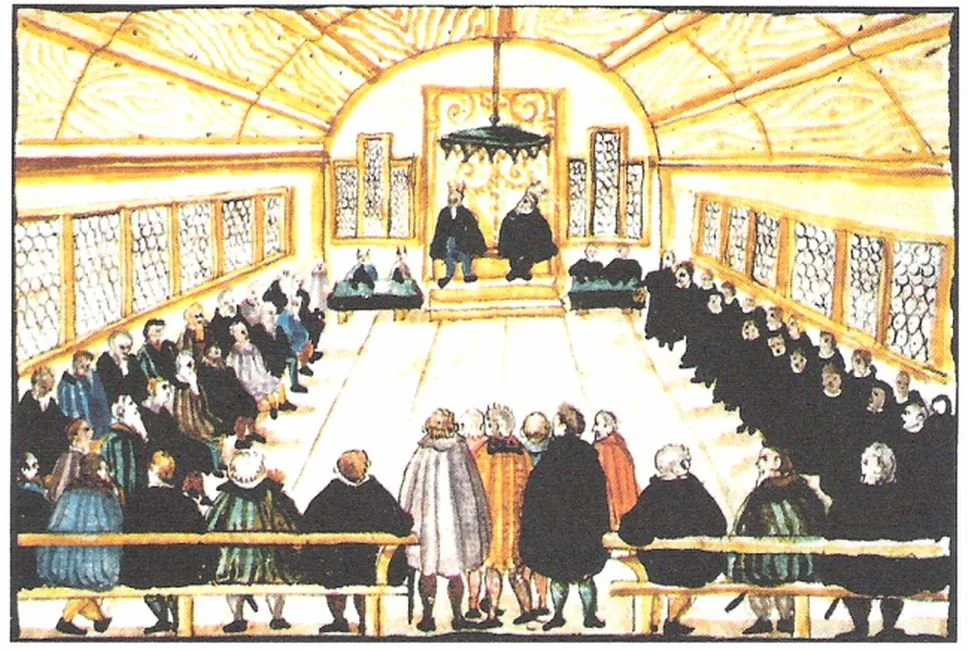
Anabaptist Disputation in Zürich, 1525, illustration c. 1605–1606. Wikimedia Commons, public domain.
George Blaurock’s death on September 6, 1529, came only four years after he participated in an event often associated with the beginning of the Anabaptist movement. A former Roman Catholic priest who became one of the most active leaders of the Radical Reformation, Blaurock spent his final years preaching, baptizing converts, establishing congregations, and repeatedly fleeing authorities. His execution by burning at Klausen in the Tyrol reflected the intense religious conflict surrounding Anabaptism during the early Reformation.
Born around 1491 or 1492 in the region of Graubünden in present-day Switzerland, Blaurock was known by several names, including Jörg Cajacob and Georg vom Hause Jakob. “Blaurock,” meaning “blue coat,” was a nickname that eventually became the name by which he was best remembered. He received an education and entered the Catholic clergy, serving for a time as a priest or vicar before leaving that position.
Blaurock eventually arrived in Zürich, where the Protestant Reformation was already transforming the religious life of the city under Huldrych Zwingli. Zwingli and his supporters rejected a number of traditional Catholic teachings and practices, but some of the younger reformers around him concluded that the reforms did not go far enough. Among them were Conrad Grebel and Felix Manz.
One of the most important disagreements concerned baptism. Zürich’s reformers continued the traditional practice of baptizing infants. Grebel, Manz, Blaurock, and their associates increasingly argued that baptism should instead follow an individual’s profession of Christian faith. The dispute also raised a larger question: who possessed authority over the church? In Zürich, as elsewhere in Reformation Europe, political authorities played an important role in determining officially accepted religious practice. The emerging radicals increasingly envisioned congregations composed voluntarily of professing believers rather than a territorial church encompassing the population.
The dispute reached a turning point in January 1525. Zürich authorities ordered parents to have infants baptized and prohibited the radicals from continuing their unauthorized religious activities. On January 21, a small group gathered at the home of Felix Manz. According to the early Anabaptist account of the meeting, Blaurock asked Conrad Grebel to baptize him. Grebel did so, after which Blaurock baptized others in the gathering.
The participants understood these baptisms as Christian baptism based upon personal faith. Their opponents called them “Anabaptists,” or rebaptizers, because the authorities considered their infant baptisms valid and therefore regarded the new ceremony as a second baptism. What occurred in Zürich became one of the foundational events in the development of the Swiss Brethren and the broader Anabaptist tradition.
Blaurock quickly emerged as an energetic preacher. The movement spread into communities outside Zürich, particularly Zollikon, but authorities responded with arrests, imprisonment, fines, expulsions, and eventually executions. The conflict was not simply an abstract theological disagreement. In sixteenth-century Europe, religious unity was commonly regarded as essential to political and social order, and rejection of officially sanctioned baptism challenged the relationship between church and government.
Blaurock experienced that repression personally. He was repeatedly arrested and expelled from territories where he preached. His colleague Conrad Grebel died in 1526, probably from plague. On January 5, 1527, Zürich authorities executed Felix Manz by drowning in the Limmat River. Blaurock was publicly beaten and expelled from Zürich that same day.
Rather than ending his ministry, the expulsion pushed Blaurock into new territory. He traveled through parts of Switzerland before eventually moving into the Tyrol, then under Habsburg rule. There he found communities receptive to Anabaptist preaching. The region became an important center for the movement despite increasingly severe persecution.
During 1529, Blaurock traveled extensively through the Tyrol with Hans Langegger, preaching, conducting baptisms, encouraging existing groups, and helping establish new congregations. His activities extended through communities including Glurns, Schlanders, Meran, Bozen, Ritten, and Klausen. By this point, authorities throughout the region were actively attempting to suppress Anabaptism.
Blaurock and Langegger were arrested in August 1529 and interrogated under torture. The accusations against Blaurock involved central elements of his Anabaptist beliefs and activities, including his rejection of infant baptism, his practice of believers’ baptism, and his rejection of traditional Catholic practices such as the Mass.
On September 6, 1529, Blaurock and Langegger were executed by burning at Klausen, today Chiusa in northern Italy. Blaurock was approximately thirty-seven years old. His death did not end Anabaptism in the Tyrol. Other leaders, most notably Jakob Hutter, continued organizing Anabaptist communities in the region. Severe persecution eventually drove many Tyrolean Anabaptists toward Moravia, where communities associated with Hutter developed into the tradition later known as the Hutterites.
Blaurock also left a literary legacy. Two hymns attributed to him were preserved in the Ausbund, the historic Anabaptist hymnal that became especially important among later Anabaptist communities.
Why It Matters
George Blaurock belonged to the small circle of reformers whose actions in Zürich in 1525 helped establish the Swiss Anabaptist movement. His preaching helped carry Anabaptism beyond Zürich into the Tyrol, while his execution illustrates the severe persecution faced by early Anabaptists from governments attempting to enforce religious conformity. The Anabaptist traditions that survived this period eventually contributed to the development of Mennonite, Amish, and Hutterite communities.