
September 8, 1636 - Harvard College Founded
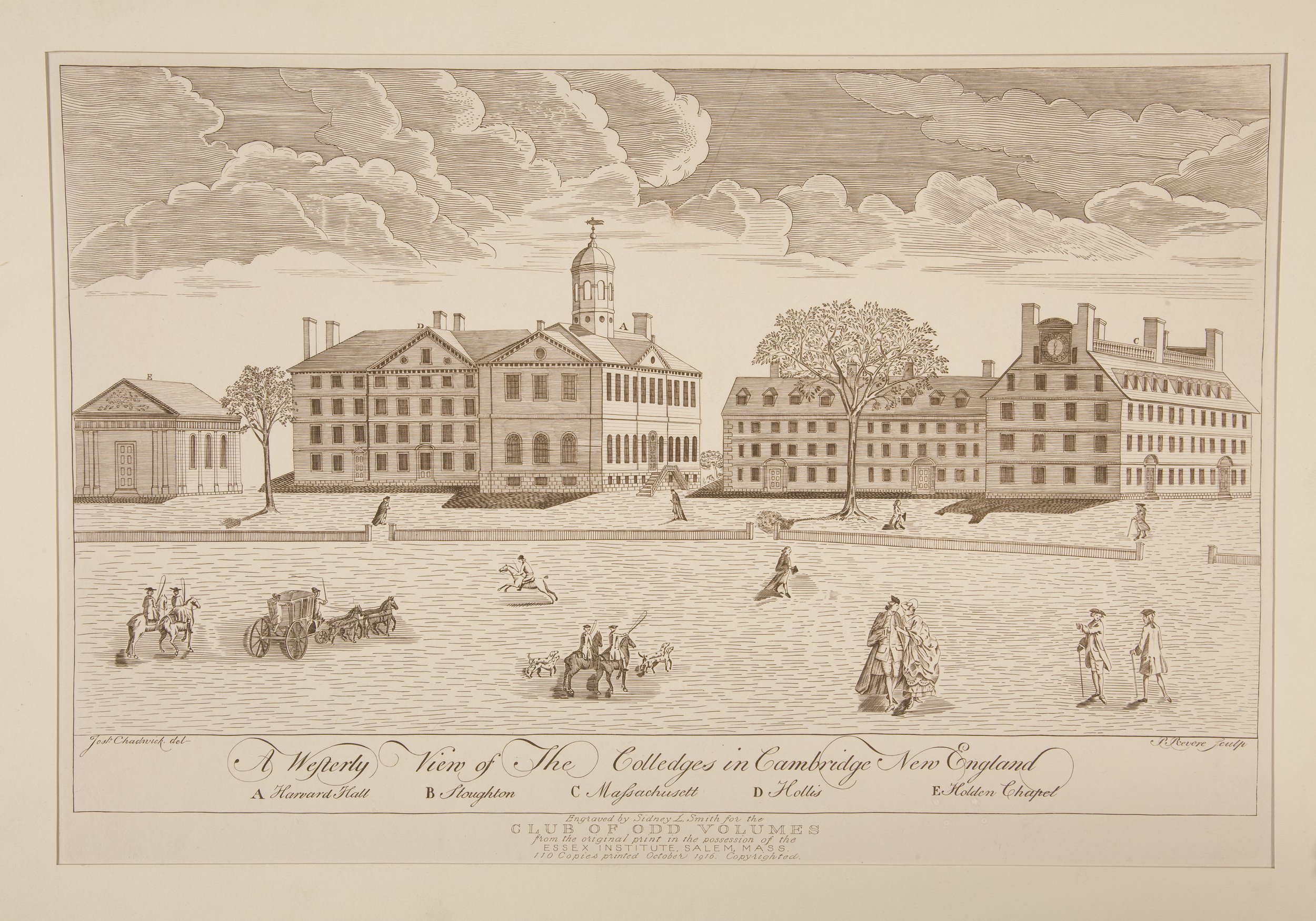
Paul Revere, A Westerly View of the Colledges in Cambridge New England, 1767, engraving after Joseph Chadwick. Yale University Art Gallery, Mabel Brady Garvan Collection. Public domain.
Education was not an afterthought for the Puritans who settled Massachusetts Bay. Within only a few years of establishing their colony, they began planning an institution of higher learning that could educate the next generation of ministers. On September 8, 1636, according to the calendar then in use, the Massachusetts General Court voted £400 toward the establishment of what would become Harvard College—the first institution of higher education in the English colonies of North America.
The decision reflected the deeply religious character of early Massachusetts. The Puritans had come from England determined to build churches and communities ordered according to their understanding of Scripture. Unlike the Separatists who established Plymouth Colony, many Massachusetts Puritans had originally hoped to reform the Church of England rather than abandon it. In New England, however, they created their own Congregational churches and placed enormous importance on preaching, biblical literacy, and an educated ministry.
Many of the colony’s first ministers had received university educations in England, especially at Cambridge. The Puritans understood that this first generation would eventually die and that ministers would have to be trained in America if their churches were to continue. Their concern was stated plainly in New Englands First Fruits, published in 1643. After establishing homes, churches, and civil government, the colonists explained that one of their next priorities was to “advance Learning and perpetuate it to Posterity.” They particularly feared leaving future churches with what they called an “illiterate Ministery.”
The college was therefore closely connected to the Puritan effort to establish a lasting Christian society in New England. Christian historian Edwin Gaustad described early Harvard as an institution that “faithfully reflected the Puritan community.” Its purpose extended beyond ministerial preparation—the colony also needed educated magistrates, teachers, and other leaders—but training ministers was central to its early mission.
The institution was not originally called Harvard. In 1637, the General Court ordered that the college be located at New Towne, a settlement across the Charles River from Boston. The town was soon renamed Cambridge, recalling the English university where many Puritan ministers had studied.
John Harvard entered the story only after the college had been established. Contrary to a common version of the story, he did not come to Massachusetts to found or lead the school. Harvard was an English Puritan minister educated at Emmanuel College, Cambridge, an institution with particularly strong connections to English Puritanism. He and his wife, Ann, emigrated to Massachusetts in 1637, and Harvard became a teaching elder in the church at Charlestown.
His time in New England was brief. Harvard died in September 1638, probably of tuberculosis. In his will, he left approximately half of his estate and his personal library to the struggling college. His gift was substantial enough that in March 1639 the General Court ordered that the institution be called Harvard College in his honor.
The religious purpose of the college became especially clear in its early regulations. Harvard’s 1646 “Rules and Precepts” instructed every student to recognize that the principal purpose of his life and studies was to know God and Jesus Christ, explicitly invoking John 17:3. Students were expected to read Scripture regularly and be prepared to demonstrate their knowledge of it.
This did not mean Harvard functioned simply as a Bible school or theological seminary. Its curriculum reflected the classical education of seventeenth-century European universities. Students studied Latin, Greek, Hebrew, rhetoric, logic, philosophy, and other subjects. For prospective ministers, however, such learning had a direct religious purpose. Knowledge of Greek and Hebrew helped ministers study the biblical texts, while rhetoric and logic prepared them to preach and defend theological arguments.
Harvard’s earliest years were not without difficulties. Its first schoolmaster, Nathaniel Eaton, was dismissed following accusations of severe mistreatment of students. More stability came after Henry Dunster became the college’s first president in 1640. Under Dunster, Harvard developed its curriculum and institutional structure, and in 1642 it held its first commencement, graduating nine students.
The relationship between Harvard and Puritan Christianity also reveals something larger about the religious culture of colonial New England. Puritans emphasized literacy partly because they believed Christians should know Scripture. Education therefore became intertwined with their efforts to sustain churches, families, and civil government. Harvard represented the highest level of an educational system intended to preserve that religious and intellectual culture across generations.
That relationship would not remain unchanged. By the beginning of the eighteenth century, some Congregational ministers believed Harvard had moved away from the theological orthodoxy of its founders. Those concerns contributed to the establishment of the Collegiate School in Connecticut in 1701, which later became Yale College. Harvard itself continued evolving, eventually moving far beyond its original Puritan identity.
Over the following centuries, many American colleges were likewise established within particular Christian traditions. Harvard's history therefore belongs not only to the history of American higher education but also to the history of Christianity in America. The college founded by Massachusetts Puritans in 1636 became an early example of the close relationship between churches, ministerial training, and higher education that characterized much of early American academic life.
Why It Matters
Harvard's founding demonstrates how seriously the Puritans of Massachusetts Bay regarded the education of future ministers and the preservation of their religious institutions. Its establishment helped create a pattern followed by later colonial colleges, many of which were founded by Christian denominations or clergy to educate ministers and other leaders. Harvard's later theological transformation, and the resulting concerns that contributed to Yale's founding, also illustrate how debates over Christian doctrine became intertwined with the development of American higher education.