
June 7, 1066 - Prince Gottschalk Murdered
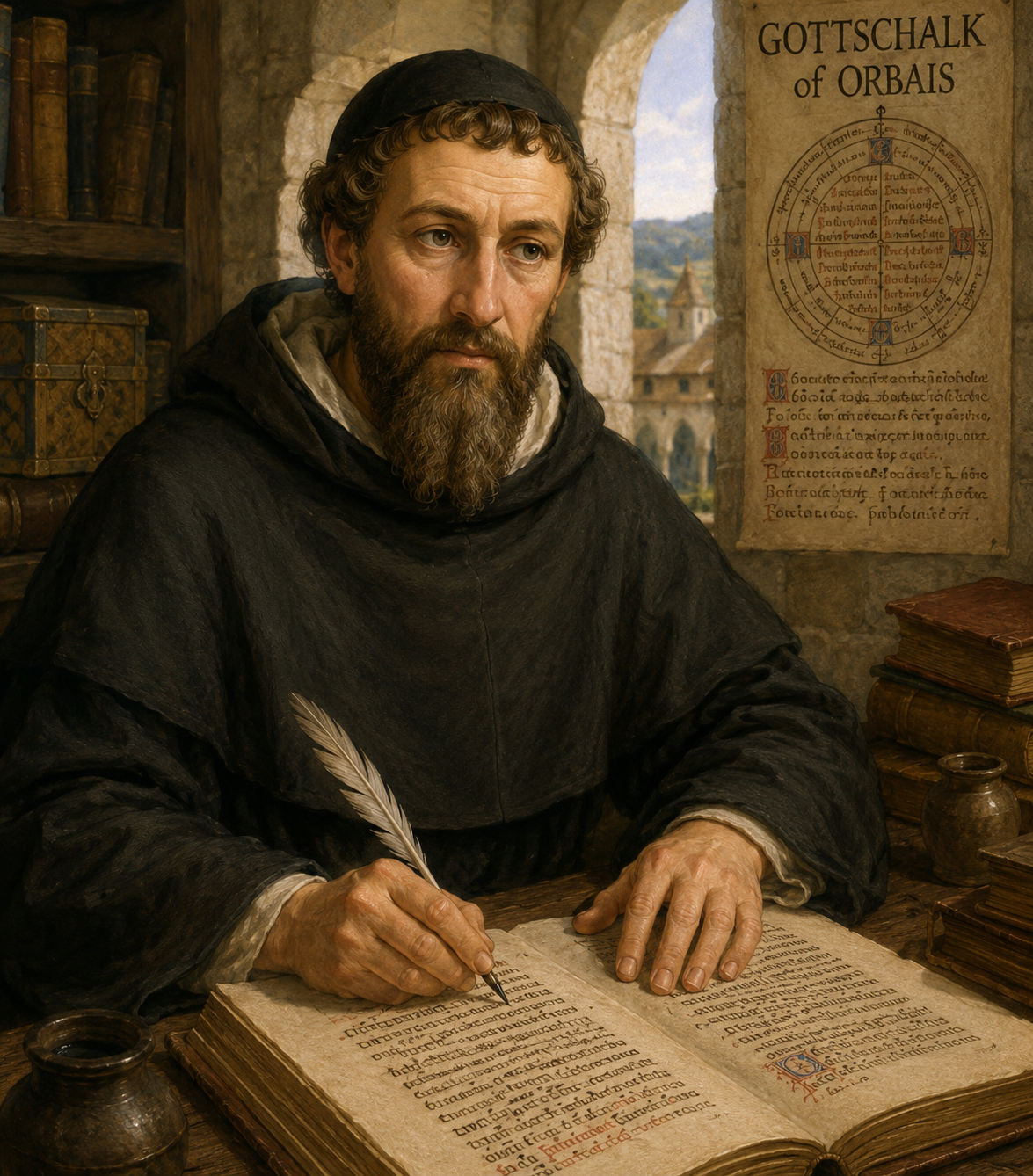
AI-generated interpretation of Gottschalk of Orbais in a Carolingian-era scriptorium. Created with artificial intelligence for historical presentation purposes, 2026.
The Christianization of northern Europe was not a simple or peaceful process. For centuries after much of Western Europe had formally embraced Christianity, many regions along the Baltic coast remained religiously divided and politically unstable. Tribal alliances shifted constantly, warfare was common, and rulers often found themselves caught between older pagan traditions and the growing influence of Christianity from neighboring kingdoms.
One important figure in this turbulent period was Gottschalk, a prince of the Obotrite Confederation, a loose alliance of Slavic tribes located in parts of what are now northern Germany, including Mecklenburg and Holstein. The Obotrites frequently fought or negotiated with surrounding powers such as the Danes, Saxons, and Swedes, and political survival often depended on temporary alliances and military strength.
Although Christian influence had spread into the region through neighboring rulers and missionaries dating back to the era of Charlemagne, many among the Obotrites still practiced traditional pagan religions. Gottschalk, however, became committed to Christianity and sought to encourage the spread of the faith among his people. Unlike some rulers who accepted Christianity primarily for political advantage, sources portray Gottschalk as personally devoted to advancing Christian teaching and church life within his territories.
His efforts placed him in direct conflict with pagan factions who opposed both Christianity and growing foreign influence in the region. Religious identity during this period was often deeply tied to political independence, tribal customs, and resistance to outside authority. As tensions intensified, opposition to Gottschalk eventually turned violent.
On June 7, 1066, pagan rebels overthrew and killed him during an uprising against Christian influence among the Obotrites. Despite his death, later Christian traditions honored him as a martyr for the faith, and he was eventually recognized as a saint.
Gottschalk’s death illustrates how dangerous and uncertain the spread of Christianity could be in medieval northern Europe. Conversion was rarely instantaneous, and conflicts between paganism and Christianity sometimes continued for generations.
Why This Matters
Gottschalk’s story reminds modern readers that the spread of Christianity throughout Europe was often gradual, contested, and costly. His life also demonstrates how faith and politics were deeply intertwined during the medieval era. For Christians today, his example reflects the risks some believers faced in attempting to lead religious reform and share the Gospel in hostile environments.