
March 24, 1726 - Daniel Whitby Dies
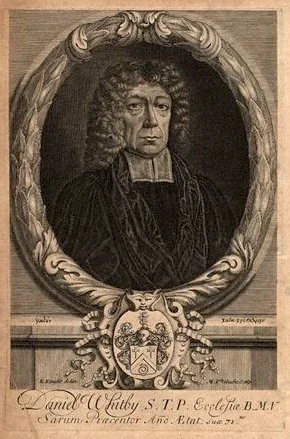
Daniel Whitby. Engraved portrait, early 18th century. Public domain.
Daniel Whitby died in Salisbury, England. An Anglican clergyman and theologian, Whitby became one of the most controversial divines of his generation.
Educated at Oxford and serving within the Church of England, Whitby engaged in vigorous theological debates—especially against Calvinist doctrines of unconditional election and irresistible grace. His writings argued for a broader understanding of human responsibility in salvation and helped shape Arminian currents within Anglican theology.
Later in life, Whitby moved toward Unitarian views, questioning traditional Trinitarian formulations—an indication of the growing rational and theological shifts of the early Enlightenment period.
Whitby’s most lasting legacy, however, lies in eschatology. Though not the first to articulate the idea, he provided the first systematic and influential defense of postmillennialism—the belief that the gospel will gradually transform the world, ushering in a prolonged era of righteousness before Christ’s final return. His optimistic vision of history would deeply influence Protestant missionary expansion and nineteenth-century evangelical confidence in societal reform.
Whitby remains a significant figure in the history of Anglican theology, Calvinist–Arminian controversy, and Christian views of the millennium.
