
September 13, 1601 - Patriarch of Alexandria Meletius Pegas
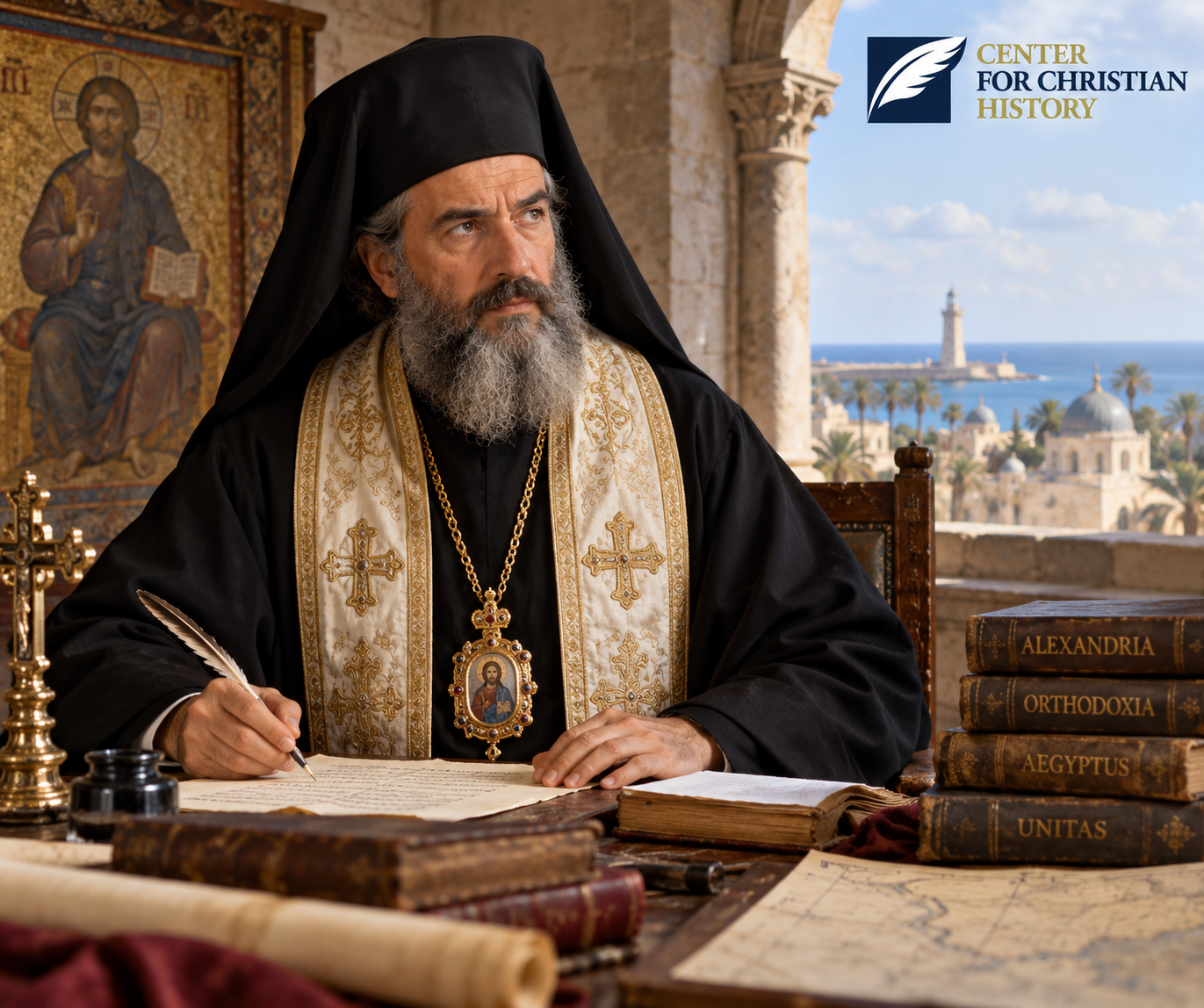
AI-generated historical reconstruction of Meletius Pegas (c. 1549–1601), Patriarch of Alexandria, in Alexandria around AD 1600. Created with OpenAI for the Center for Christian History, 2026. Historical reconstruction; not a contemporary portrait.
On September 13, 1601, Meletius Pegas, one of the most influential Eastern Orthodox churchmen of the late sixteenth century, died in Alexandria at about fifty-two years old. His career unfolded during an era when ancient Christian divisions collided with the religious conflicts created by the Protestant Reformation and Catholic Counter-Reformation. As Patriarch of Alexandria, Meletius attempted something particularly ambitious: defending Eastern Orthodoxy against Roman Catholic influence while simultaneously seeking closer relations with the Coptic Christians of Egypt.
Born around 1549 in Candia, modern Heraklion, on the Venetian-controlled island of Crete, Meletius grew up at an unusual crossroads between the Greek Orthodox and Latin Catholic worlds. He received an extensive education and studied at Padua in Italy, one of Europe's leading universities. He became proficient in Greek, Latin, and Italian and studied subjects that included philosophy and medicine. His Western education gave him firsthand familiarity with Roman Catholic theology and intellectual culture, although he ultimately became one of Catholicism's most determined Orthodox opponents.
After entering monastic life, Meletius became associated with the Patriarchate of Alexandria. He served under Patriarch Sylvester and eventually became his protosyncellus, roughly equivalent to a senior administrative officer or chancellor. Following Sylvester's death, Meletius succeeded him as Patriarch of Alexandria in 1590.
The patriarchate he inherited faced serious difficulties. Egypt had been part of the Ottoman Empire since 1517, and the Greek Orthodox community represented only one Christian population within a predominantly Muslim society. The Alexandrian patriarchate also struggled with substantial financial obligations to Ottoman authorities. Meletius worked to stabilize its finances and strengthen its institutions while becoming increasingly involved in controversies extending far beyond Egypt.
One of the most important involved the Coptic Orthodox Church. The division between the Coptic and Greek Orthodox churches stretched back to the theological disputes surrounding the Council of Chalcedon in AD 451. By Meletius's lifetime, they had existed as separate Christian communions for more than eleven centuries.
Yet another Christian force had entered the situation. Catholic missionaries, particularly Jesuits, were working among Eastern Christians as part of Rome's expanding missionary and diplomatic activity during the Counter-Reformation. Meletius strongly resisted efforts to bring Orthodox Christians under papal authority. He also became involved when Catholic representatives developed relations with Coptic leaders.
His response reveals an important complexity in his theology. Meletius opposed papal supremacy and criticized several Roman Catholic teachings, yet opposition to Rome did not mean rejecting every doctrine associated with Catholicism. Sources describe him as accepting transubstantiation, the teaching that the bread and wine of the Eucharist truly become Christ's body and blood. The theological boundaries separating Catholics, Orthodox, and Protestants in this period therefore cannot always be mapped neatly onto later denominational assumptions.
At the same time that Meletius resisted Catholic influence among the Copts, he sought a rapprochement between the Coptic and Greek Orthodox communities. He extended his efforts beyond Egypt to the Ethiopian Church as well. The attempt did not produce lasting reunion. The theological and ecclesiastical separation between the Chalcedonian Greek Orthodox and Oriental Orthodox traditions was far too deeply established to be overcome by the efforts of one patriarch.
Meletius's influence reached even farther. In 1593, he participated in the Constantinople synod that confirmed the establishment of the Patriarchate of Moscow, an important development in the growing prominence of Russian Orthodoxy.
He also became involved in the religious struggle occurring in the Polish-Lithuanian Commonwealth. The Union of Brest of 1596 brought a portion of the Eastern Christian hierarchy there into communion with Rome while retaining the Byzantine liturgy and many Eastern practices. Meletius opposed the union and corresponded with Orthodox leaders resisting it. Among the men he sent to assist Eastern Orthodox Christians in the region was his younger associate Cyril Lucaris, who would later become one of the seventeenth century's most controversial Orthodox patriarchs.
Meletius's standing became so great that while remaining Patriarch of Alexandria he was called upon to oversee the Ecumenical Patriarchate of Constantinople during a period of instability in the late 1590s. His responsibilities consequently connected Alexandria, Constantinople, Moscow, Poland-Lithuania, Crete, and the Christian communities of Egypt.
Meletius died in Alexandria in September 1601. Cyril Lucaris succeeded him as Patriarch of Alexandria. The Eastern Orthodox Church later honored Meletius as a saint and commemorates him on September 13.
Why It Matters
Meletius Pegas's career illustrates how interconnected Christianity had become across the eastern Mediterranean and Eastern Europe by the end of the sixteenth century. His involvement with the Copts, Catholic missionaries, the Union of Brest, and the recognition of the Moscow Patriarchate placed him at the intersection of several major developments reshaping early modern Christianity. His unsuccessful attempt at rapprochement with the Copts also belongs to the much longer history of relations between Eastern Orthodox and Oriental Orthodox Christians.
