
September 18, 1975 - Chile’s Growing Pentecostal Voice
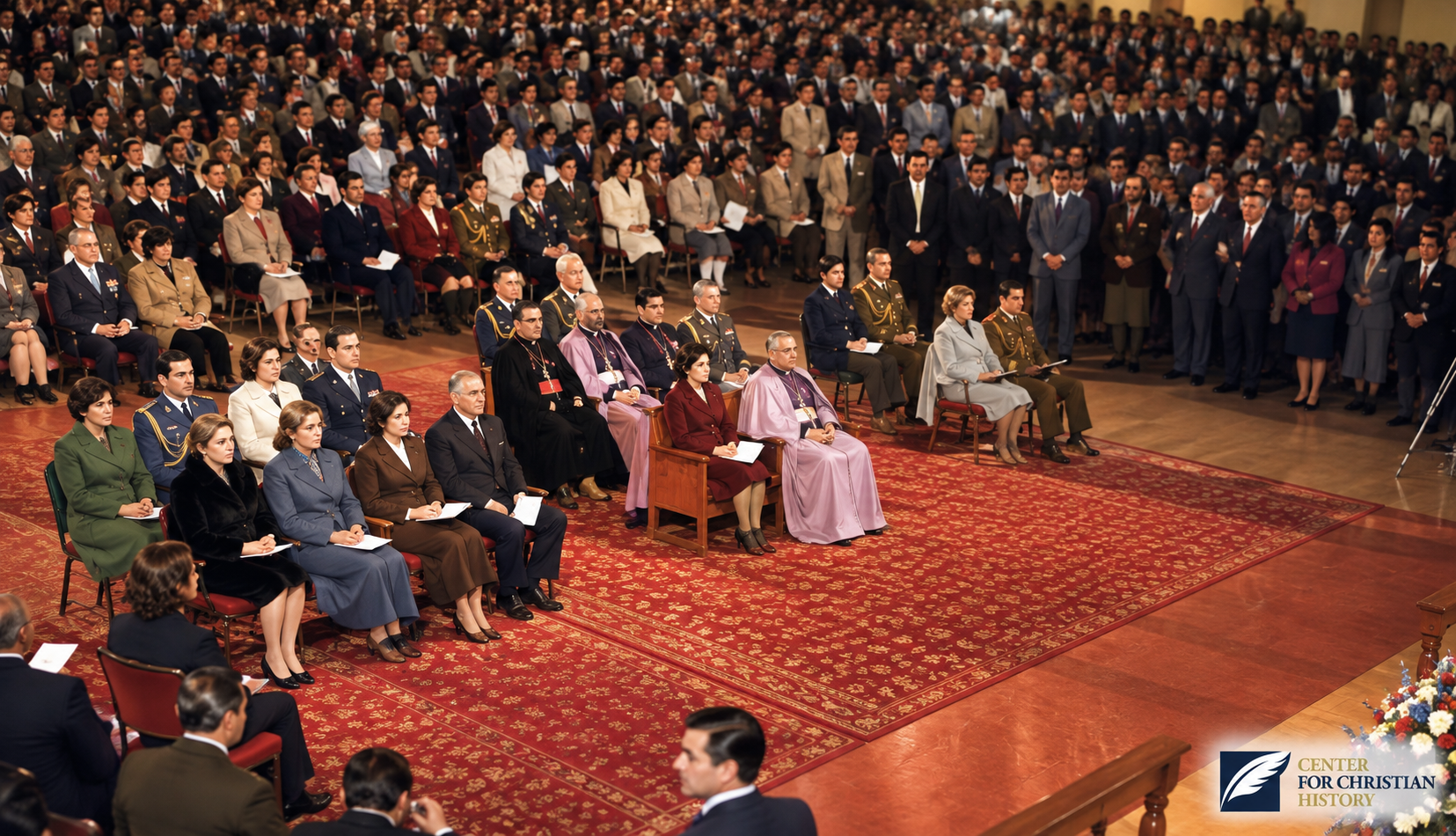
AI-generated historical reconstruction of an Evangelical Te Deum service in Chile, based on a historical photograph of the ceremony. Created with OpenAI, 2026, for the Center for Christian History.
When Chileans celebrated their national independence on September 18, 1975, the country’s traditional Te Deum was no longer the only major Christian service associated with the national celebration. Just four days earlier, on September 14, Chile’s rapidly growing evangelical community had held the country’s first Evangelical Te Deum, formally known as the Servicio de Acción de Gracias or Service of Thanksgiving. The new ceremony connected Chile’s September independence observances with one of the most significant developments in twentieth-century Latin American Christianity: the extraordinary growth of Pentecostalism.
Pentecostalism in Chile had roots reaching back more than six decades. Its emergence is usually traced to a revival that began within the Methodist Episcopal Church in Valparaíso in 1909. One of its principal leaders was Willis Collins Hoover, an American Methodist missionary who had become interested in reports of Pentecostal revival and teachings about the baptism of the Holy Spirit. Prayer meetings and extended worship services increasingly emphasized experiences that participants interpreted as manifestations of the Holy Spirit, including speaking in tongues, prophecy, visions, and healing.
The revival soon produced tension within the Methodist Episcopal Church. Hoover and many of his followers eventually separated from the denomination, and in 1910 the movement that became the Methodist Pentecostal Church of Chile began developing independently. Chilean Pentecostalism subsequently grew through local congregations, lay participation, street preaching, testimony, prayer meetings, and evangelistic services.
Over the following decades, Pentecostal Christianity became an increasingly visible part of Chilean society. The movement experienced denominational divisions, but those divisions did not prevent its continued expansion. Pentecostal churches became particularly influential among working-class Chileans and eventually constituted the largest segment of the country's Protestant population.
Their growth occurred alongside significant changes in Chile’s religious establishment. Historically, the Roman Catholic Church had occupied a privileged position in Chilean public life. The Constitution of 1925, however, formally separated church and state and provided greater legal space for religious minorities.
The annual Te Deum remained an important symbol of Christianity’s place in Chilean national life. Its name comes from the ancient Christian hymn Te Deum laudamus, meaning “We praise you, God.” The service became closely associated with Chile’s September 18 national celebration, commemorating the establishment of the First Government Junta on September 18, 1810, an event traditionally associated with the beginning of Chilean independence.
An important change occurred under President Salvador Allende. Beginning in 1970, the traditional Te Deum became ecumenical, incorporating representatives of evangelical and Orthodox churches as well as the Jewish community. The September 18 observance therefore already reflected greater religious diversity before the establishment of a separate evangelical service.
The political circumstances surrounding the first Evangelical Te Deum were complicated. Allende was overthrown in a military coup on September 11, 1973, and General Augusto Pinochet became the dominant figure in Chile’s military government. Some Catholic, mainline Protestant, and Pentecostal Christians became involved in efforts to defend human rights. At the same time, other evangelical and Pentecostal leaders developed cooperative relationships with the military government. Chilean Protestantism was therefore not united in its response to Pinochet.
In December 1974, Pinochet attended the inauguration of the large Methodist Pentecostal cathedral in Santiago, commonly associated with Jotabeche. The following year, evangelical leaders organized a separate national service of thanksgiving.
On Sunday, September 14, 1975—the Sunday immediately preceding Chile’s September 18 national celebration—the first Evangelical Te Deum was held at the recently inaugurated Methodist Pentecostal cathedral in Santiago. Methodist Pentecostal bishop Mamerto Mancilla Tapia and pastor Javier Vásquez Valencia presided over the ceremony, which was attended by Pinochet and other senior government officials.
The timing connected the service directly to the approaching Fiestas Patrias. Thus, while September 18 itself was not the date of the first Evangelical Te Deum, the new service was created as an evangelical observance connected to Chile’s September 18 independence celebration. The distinction is important: Chile continued to hold its traditional ecumenical Te Deum associated with September 18, while evangelicals developed their own national Service of Thanksgiving immediately before the holiday.
For evangelical leaders, the 1975 ceremony also represented public recognition for churches that had long existed outside Chile’s traditional Catholic establishment. The relationship between some of those leaders and Pinochet remains an important and controversial part of the service’s early history, but the Evangelical Te Deum survived the dictatorship and continued after Chile returned to democracy. In 1997, the government of President Eduardo Frei Ruiz-Tagle formally recognized the Evangelical Service of Thanksgiving as part of the country’s official Fiestas Patrias observances.
Why It Matters
The events surrounding September 18, 1975, demonstrated how dramatically Chile’s religious landscape had changed since the Pentecostal revival of 1909. The first Evangelical Te Deum on September 14 gave the country’s growing evangelical and Pentecostal population a separate national ceremony tied directly to the September 18 independence celebration, establishing a tradition that continued under both military and democratic governments.
