
September 19, 1971 – Biblical Archaeologist William F. Albright
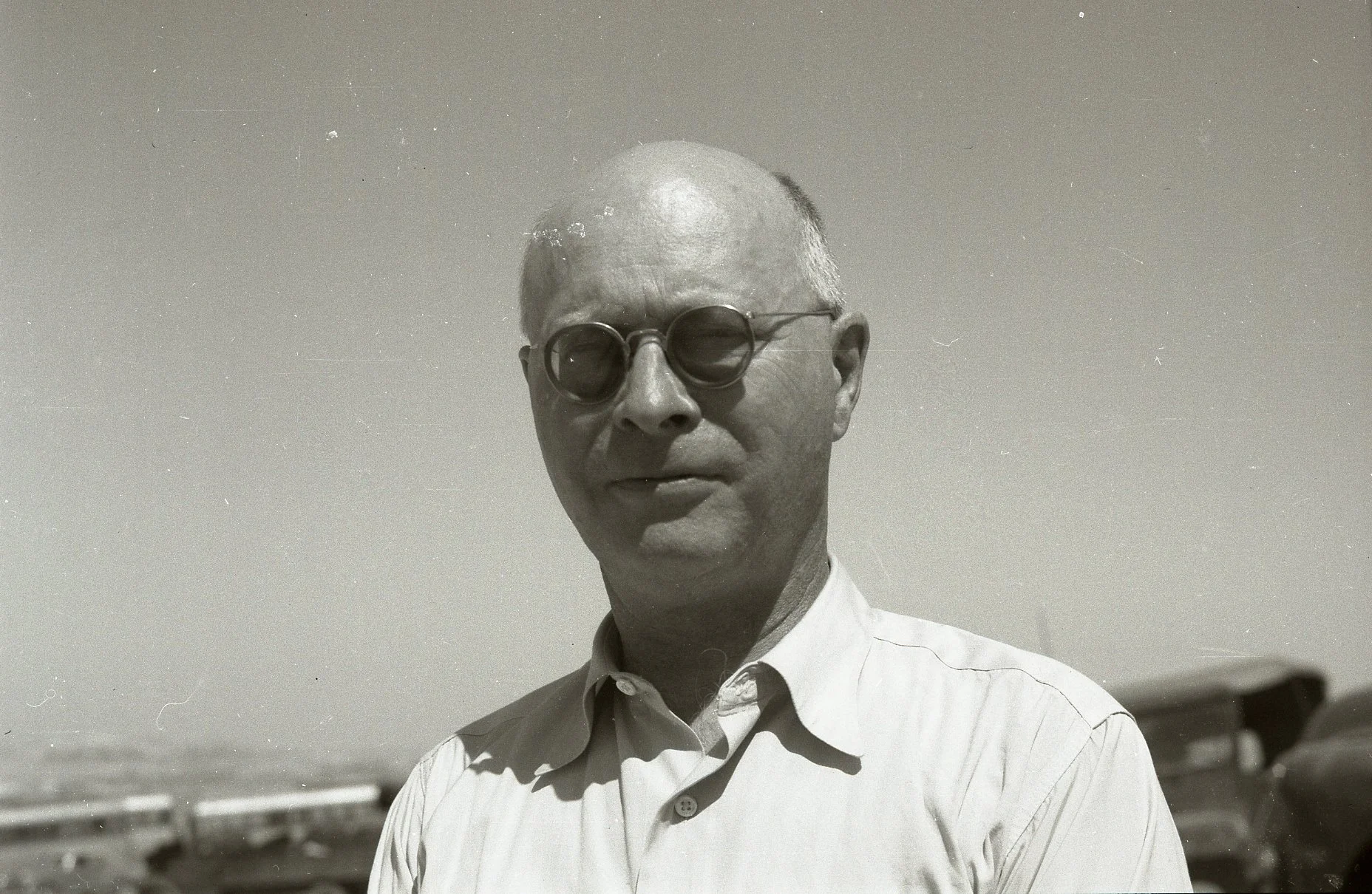
William F. Albright at Beersheba, 1953. Israel National Photo Collection, Government Press Office. Public Domain. Via Wikimedia Commons.
On September 19, 1971, William Foxwell Albright, one of the most influential biblical archaeologists of the twentieth century, died in Baltimore, Maryland, at the age of eighty. During a career spanning more than half a century, Albright helped transform the study of the ancient Near East and became particularly famous for using archaeological evidence to investigate the historical world described in the Bible.
Albright was born on May 24, 1891, in Coquimbo, Chile, where his American parents, Wilbur and Zephine Albright, were Methodist missionaries. Christianity and Methodism were therefore part of his life from childhood. So too was an unusual fascination with the ancient world. While still a boy, Albright became interested in the history of Egypt, Mesopotamia, and the peoples of the Bible. That childhood interest eventually developed into a remarkably broad scholarly career encompassing archaeology, ancient languages, biblical studies, pottery, inscriptions, and the history of the ancient Near East.
After studying classics at Upper Iowa University, Albright entered Johns Hopkins University, where he received his doctorate in 1916. He later traveled to the Middle East and became associated with the American School of Oriental Research in Jerusalem, serving for years as its director. In 1929, he returned to Johns Hopkins as a professor of Semitic languages and became one of the most influential teachers of biblical and Near Eastern studies in the United States.
Albright conducted or participated in archaeological work at numerous sites connected with the ancient biblical world. He excavated at Tell el-Ful, which he identified with biblical Gibeah, associated with King Saul, and worked at Bethel and Petra. His most important excavation, however, was at Tell Beit Mirsim, a site he believed to be biblical Debir. There he helped refine the use of pottery to establish chronological sequences for archaeological sites. This type of ceramic analysis became an important tool for archaeologists attempting to determine when different levels of an ancient settlement had been occupied.
Albright believed archaeology could provide an independent body of evidence against some of the more skeptical approaches to the Old Testament that had developed among European biblical scholars during the nineteenth and early twentieth centuries. He argued that discoveries concerning ancient peoples, languages, customs, cities, and political conditions frequently demonstrated that biblical texts belonged to a genuine ancient Near Eastern historical setting.
That did not mean Albright approached every biblical passage as something that archaeology could simply “prove.” His work was scholarly rather than merely an attempt to collect artifacts that appeared to confirm individual Bible stories. Nevertheless, he remained much more confident about the historical reliability of significant portions of the biblical record than many contemporary biblical critics, and his Christian background influenced the questions he brought to the study of the ancient world.
One of Albright's most famous contributions came after the discovery of the Dead Sea Scrolls beginning in 1947. When some of the earliest manuscripts were brought to the attention of scholars, Albright quickly recognized their antiquity and helped establish their authenticity. The scrolls eventually became one of the most important manuscript discoveries in the history of biblical studies, providing texts of books of the Hebrew Bible roughly a thousand years older than many of the medieval Hebrew manuscripts previously available to scholars.
Albright's influence extended far beyond his own excavations. Through Johns Hopkins and the American School of Oriental Research, he trained or influenced a generation of major biblical scholars, archaeologists, linguists, and historians. His books, including The Archaeology of Palestine, Archaeology and the Religion of Israel, and From the Stone Age to Christianity, brought archaeological discoveries into discussions about the historical development of Israelite religion and the biblical world.
The field changed considerably after Albright's death. Later archaeologists questioned several conclusions associated with what became known as the “Albright school,” particularly attempts to correlate archaeological evidence with the patriarchs, the Exodus, and the Israelite conquest of Canaan. Modern archaeologists are generally more cautious about treating archaeology as a means of demonstrating the historical accuracy of biblical narratives. Archaeology can illuminate the cultures, economies, settlements, languages, and material world in which biblical literature developed, but individual discoveries rarely “prove the Bible” in the sweeping manner sometimes claimed in popular discussions.
That change does not erase Albright's importance. Even scholars who reject many of his conclusions recognize the enormous role he played in making biblical archaeology a professional academic discipline. His insistence that questions about biblical history should be examined alongside physical evidence from the ancient world helped establish an approach that continues, although with different assumptions and methods, more than a century later.
Why It Matters
William F. Albright helped establish biblical archaeology as a major field of twentieth-century scholarship and shaped generations of archaeologists and biblical scholars. Although many of his specific conclusions have subsequently been revised or challenged, his effort to place the Bible within the archaeological, linguistic, and cultural setting of the ancient Near East permanently influenced the academic study of biblical history.
