
September 10, 1922 - Romania’s First Pentecostal Congregation
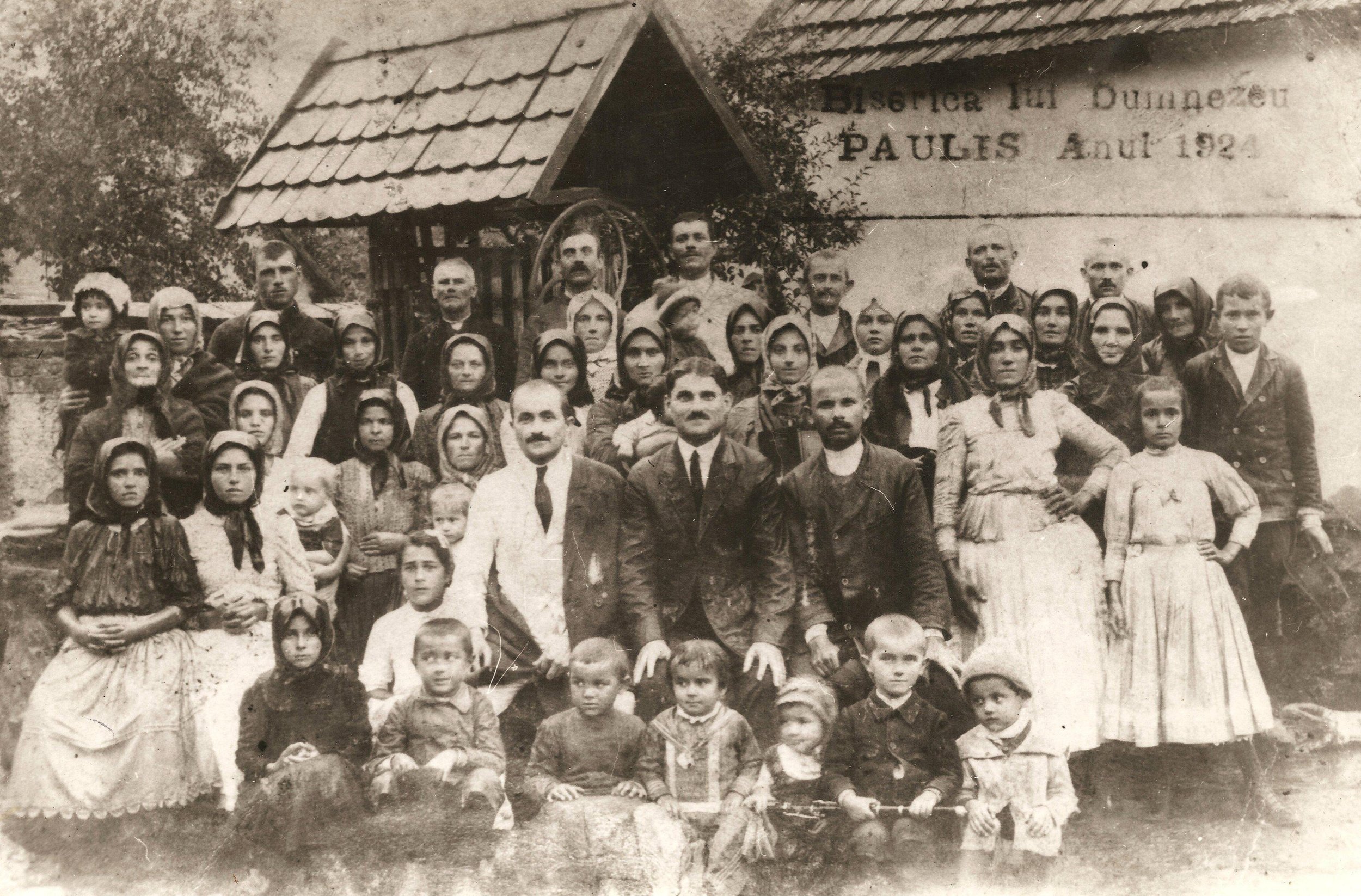
Members of the early Pentecostal congregation at Păuliș, Romania, 1924. The congregation organized in 1922 and became an important starting point for the Romanian Pentecostal movement. Photographer unknown.
A small gathering in the western Romanian village of Păuliș became the center from which Pentecostalism would spread across Romania. On September 10, 1922, Gheorghe Bradin opened what is generally regarded as the country’s first organized Romanian Pentecostal congregation. The movement that began there would face opposition from both church and state before eventually becoming one of Romania’s largest Protestant traditions.
Pentecostalism was itself only a few decades old. It developed out of nineteenth-century Protestant revival and holiness movements and became internationally prominent following revivals in the United States during the first years of the twentieth century. Pentecostals shared many evangelical Protestant beliefs but placed particular emphasis on baptism in the Holy Spirit, spiritual gifts described in the New Testament, speaking in tongues, prophecy, and divine healing.
Exactly when Pentecostalism first reached Romania is difficult to establish. Historian Ciprian Bălăban notes evidence of Pentecostal believers among German-speaking communities in Transylvania between 1919 and 1921, while other claims place Pentecostal activity even earlier. The significance of Păuliș, therefore, is not that Pentecostal ideas had never before crossed Romania’s borders. Rather, the congregation organized there in 1922 became the nucleus from which an enduring Romanian Pentecostal movement developed.
Its origins also reveal how closely European and American Christianity had become connected through immigration. Large numbers of Eastern Europeans had emigrated to the United States, and religious ideas traveled back across the Atlantic through letters, books, periodicals, missionaries, and returning immigrants. Romanian Pentecostalism emerged partly through these transatlantic networks.
Gheorghe Bradin was already part of Romania’s Protestant minority. He had been associated with the Baptists for several years and had become a local religious leader. His wife, Persida, suffered from serious illness, and the couple heard reports that Pentecostal Christians in America practiced prayer for divine healing. Bradin eventually established contact with Pavel Budeanu, a Romanian immigrant in the United States who had embraced Pentecostalism.
According to Bradin’s later account, materials arriving from America introduced him more fully to Pentecostal teaching. His correspondence with Budeanu addressed baptism in the Holy Spirit and the spiritual gifts described in 1 Corinthians. Bradin also reported that Persida experienced a remarkable recovery after prayer in 1922. The couple understood her recovery as divine healing, an interpretation that played an important role in their acceptance of Pentecostal beliefs.
On September 10, Bradin opened the Pentecostal congregation at Păuliș. It remained closely connected to the evangelical environment from which it had emerged, and a number of its early adherents came from Baptist backgrounds. By the end of 1922, the congregation reportedly numbered about thirty people. Another congregation soon developed at nearby Cuvin.
Interestingly, the congregation existed before its members reported experiencing one of the practices that would become especially identified with Pentecostalism. Bradin later recalled that the first baptisms in the Holy Spirit among the group occurred in 1923. Thus, the community initially organized itself around Pentecostal teachings received largely through correspondence before developing the religious experiences associated with those teachings.
Pavel Budeanu strengthened the American connection when he traveled to Romania in 1924. He conducted what Romanian Pentecostal histories identify as the movement’s first Pentecostal water baptism in the country, baptizing believers in the Mureș River near Păuliș. By then, however, the movement was already attracting the attention of religious and civil authorities.
Romania was predominantly Eastern Orthodox, but Baptists, Adventists, Brethren, and other Protestant groups had also established communities there. The appearance of another Protestant movement created both theological disputes and institutional tensions. Orthodox critics regarded Pentecostal teaching and practice as a departure from historic Christianity, while Baptists disputed Pentecostal claims concerning baptism in the Holy Spirit, tongues, healing, and other charismatic gifts. The fact that many early Romanian Pentecostals came from Baptist congregations made relations between the two groups particularly complicated.
Government opposition soon became an even greater problem. Local authorities restricted Pentecostal meetings beginning in 1923. Bradin and other leaders petitioned for legal recognition, but the Romanian Ministry of Cults rejected their efforts. A January 1925 government decision specifically listed the Pentecostal group at Păuliș and Cuvin among prohibited religious organizations. Pentecostals consequently spent much of the interwar period seeking legal recognition while continuing to organize congregations.
The movement survived those restrictions and later the upheavals of World War II and Communist rule. After the war, Pentecostals received provisional recognition in 1946 and formal state recognition in 1950. Their institutional development continued under the Communist regime despite government regulation and surveillance.
What began at Păuliș in 1922 had by then become far more than a village congregation. The movement had established a permanent place within Romania’s increasingly diverse Christian landscape.
Why It Matters
The Păuliș congregation became the principal institutional starting point for the Romanian Pentecostal movement, even though Pentecostal influences may have appeared in Romania earlier. Its history also demonstrates the importance of migration and transatlantic religious networks in the international expansion of Pentecostalism. Despite prolonged struggles for legal recognition, Romanian Pentecostalism survived and developed into one of the country's major Protestant traditions.
