
September 11, 813 - Charlemagne Names Louis the Pious Co-Emperor
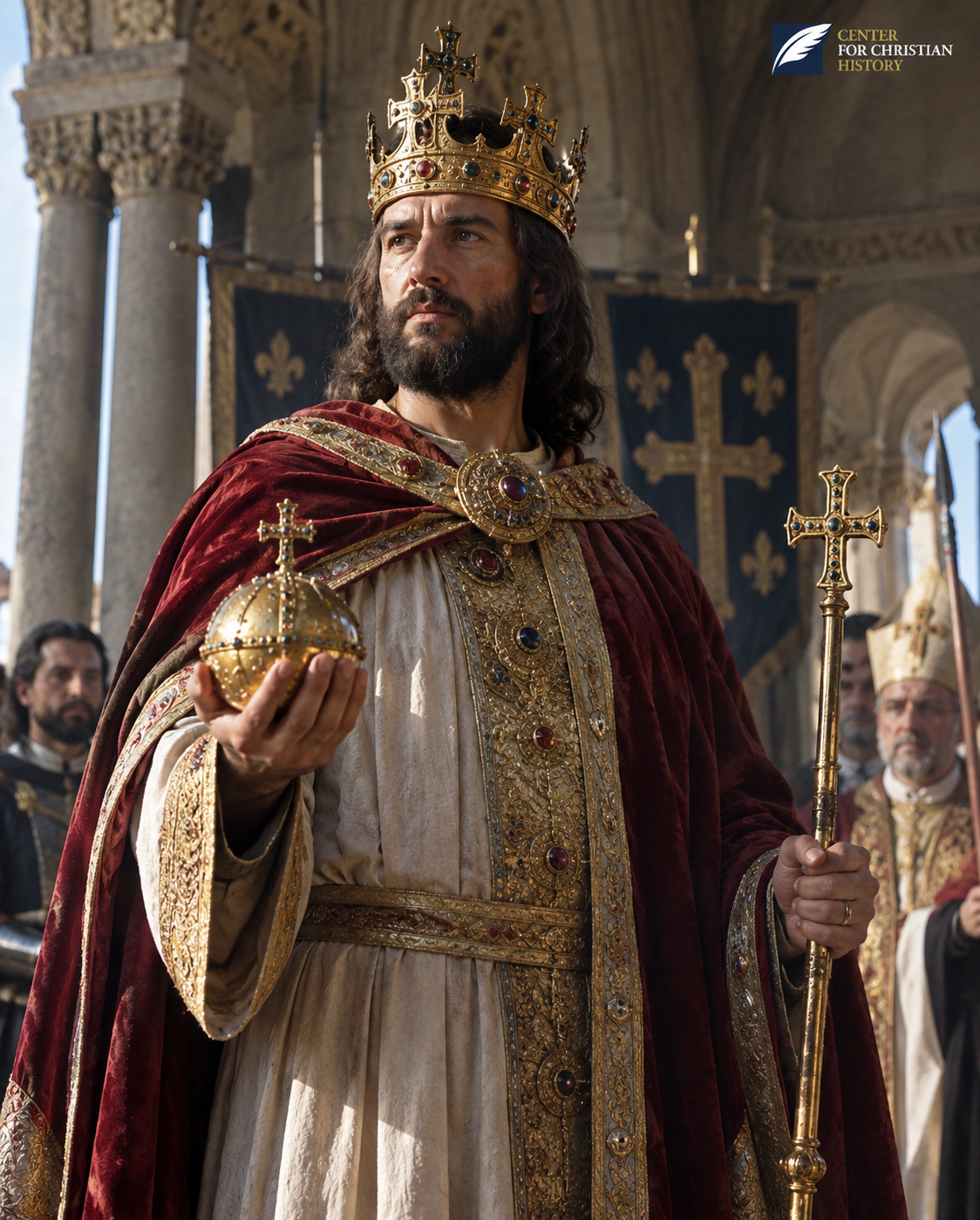
Louis the Pious. AI-generated historical reconstruction created by the Center for Christian History using ChatGPT, 2026, informed by a traditional artistic depiction of Louis the Pious.
Near the end of his long reign, Charlemagne faced a problem that had troubled rulers for centuries: succession. Two of his legitimate sons had died, leaving Louis, king of Aquitaine, as his only surviving legitimate son and heir. On September 11, 813, at Aachen, Charlemagne elevated Louis to share the imperial title with him. When Charlemagne died only a few months later, on January 28, 814, Louis inherited one of the largest political realms Western Europe had seen since the fall of the Roman Empire.
Louis had been born in 778 and was made king of Aquitaine while still a child. He therefore arrived at the imperial throne with decades of experience in royal government. Yet his reign would differ in important ways from that of his famous father. Charlemagne had closely connected military expansion, political rule, education, and Christianity. Louis continued many of his father's policies but placed particular emphasis on reforming Christian institutions and bringing the conduct of the imperial court into closer conformity with Christian moral expectations.
This emphasis earned him the name by which history remembers him: Louis the Pious.
After taking control at Aachen, Louis reorganized the imperial household. Sources describe him removing people whose behavior he regarded as immoral and eliminating some remnants of the Germanic pagan culture that Charlemagne had collected or preserved. His unmarried sisters were removed from court, while ecclesiastical advisers assumed increasingly important positions around the emperor. These actions reflected more than Louis's personal piety. They were part of a broader attempt to make Christian reform an important element of imperial government.
One of the most influential figures in that effort was Benedict of Aniane, a monk and reformer who became one of Louis's principal religious advisers. Louis supported Benedict's effort to bring greater uniformity to monastic life throughout the empire. Councils at Aachen beginning in 816 addressed the organization and discipline of monasteries and communities of clergy. The Rule of St. Benedict increasingly became the standard around which Carolingian monastic reform was organized.
Louis's reign therefore occupies an important place in the development of Western monasticism. The reforms associated with Louis and Benedict did not suddenly create Benedictine monasticism, nor were they applied uniformly everywhere, but they strengthened the position of the Benedictine Rule and helped establish patterns that influenced medieval European monasteries for centuries.
Louis also believed that an emperor himself remained accountable to Christian moral standards. That conviction produced one of the most memorable—and politically controversial—episodes of his reign.
In 817, Louis attempted to establish an orderly succession for his own sons. His eldest, Lothair, received the imperial title and a position of superiority over his brothers. The arrangement, however, threatened the position of Louis's nephew Bernard, king of Italy. Bernard rebelled, surrendered, and was convicted of treason. Although sentenced to death, his punishment was changed to blinding. The procedure was carried out so brutally that Bernard died in 818.
Louis was deeply troubled by the episode. At an imperial assembly at Attigny in 822, he publicly confessed wrongdoing and performed penance for his treatment of Bernard and others. The spectacle of an emperor acknowledging his sins before assembled churchmen and political leaders was extraordinary. Contemporary and later writers compared Louis's action to the famous penance of the Roman emperor Theodosius I.
Louis apparently intended the ceremony to demonstrate Christian humility and moral accountability. Politically, however, public penance could carry a dangerous implication: an emperor who publicly confessed serious wrongdoing could provide his opponents with evidence that his authority was fallible. Historians have consequently debated whether the penance strengthened Louis's image as a Christian emperor or ultimately weakened his political position.
The remainder of his reign demonstrated how difficult it was to combine Christian ideals, dynastic politics, and imperial government. Louis's second marriage to Judith of Bavaria produced another son, Charles, later known as Charles the Bald. Attempts to provide territory for Charles disrupted the earlier succession settlement and contributed to conflicts among Louis and his older sons. At one point Louis was removed from power and subjected to another humiliating public penance before eventually recovering his throne.
Louis died in 840. His sons continued fighting over the inheritance until the Treaty of Verdun in 843 divided much of the Carolingian Empire among them. The political unity created under Charlemagne and inherited by Louis would never be fully restored.
Why It Matters
Louis the Pious's reign illustrates how closely political authority and Christianity had become connected in the Carolingian world. His support for Benedict of Aniane and the Aachen reforms contributed to the increasing prominence of the Rule of St. Benedict in Western European monasticism. His public penance also became an important example of the complicated relationship between Christian concepts of moral accountability and medieval imperial authority.