
August 2, 1643 - Issac Jogues Turns Himself in to Iroquois
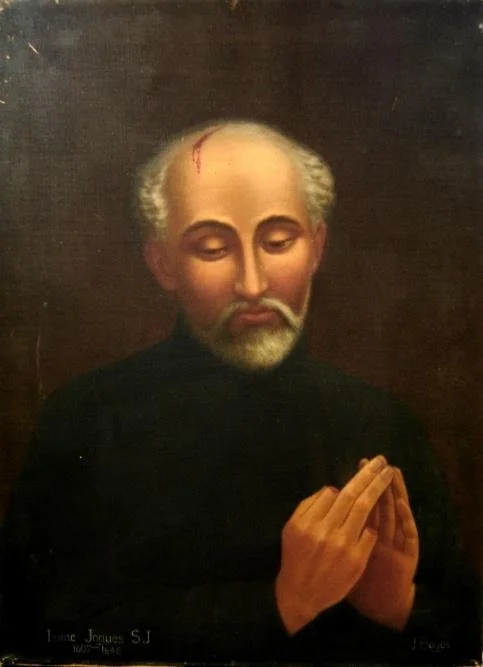
Father Isaac Jogues, S.J., half-length portrait (1904), Library of Congress Prints and Photographs Division. Public domain (published before 1930).
Isaac Jogues believed the Gospel was worth any cost. A Jesuit missionary serving in French Canada, he devoted his life to sharing Christianity among the Huron and Iroquois peoples during a time of intense conflict between rival tribes and European colonial powers. His willingness to endure suffering rather than abandon his calling made him one of the most remarkable missionary figures in Christian history.
On August 2, 1643, after a Huron war party transporting him was attacked by the Mohawk, part of the Iroquois Confederacy, Jogues faced a life-or-death decision. Rather than remain hidden and abandon his mission, he surrendered himself so that he could continue ministering to those who had captured him. During months of captivity, he was beaten, tortured, and had several fingers mutilated, injuries so severe that he could no longer properly celebrate the Roman Catholic Mass because a priest's thumb and forefinger were traditionally required to handle the consecrated host. Recognizing his extraordinary circumstances, Pope Urban VIII granted Jogues a special dispensation allowing him to continue serving as a priest despite his injuries.
After eventually escaping and returning to France, Jogues was welcomed as a hero. Yet instead of remaining safely at home, he asked permission to return to the very people who had tortured him. In 1646, he resumed missionary work among the Mohawk. Tensions between the French and the Iroquois soon worsened, and when disease and crop failures struck the villages, some blamed Jogues for bringing misfortune. On October 18, 1646, he was killed with a tomahawk, becoming one of the North American Martyrs.
Why it matters:
Isaac Jogues' life illustrates the extraordinary sacrifices many early Christian missionaries were willing to make to spread their faith. His story also highlights the complex intersection of evangelism, Native American history, and European colonial expansion in seventeenth-century North America. While modern historians recognize that these encounters were shaped by cultural misunderstandings, warfare, and competing political interests, Jogues' personal courage and unwavering commitment remain widely admired within Christian history. Today he is remembered as a martyr whose devotion to his mission ultimately cost him his life.