
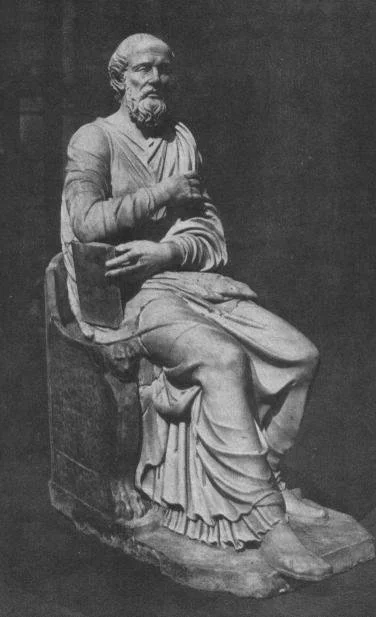
Ancient marble statue traditionally identified as Saint Hippolytus of Rome, 4th–5th century. Vatican Apostolic Library. Public Domain (via Wikimedia Commons).
Hippolytus of Rome is remembered as one of the most important defenders of Christian orthodoxy during the early third century. At a time when Gnostic teachers were spreading ideas that denied essential biblical truths, Hippolytus wrote extensively to expose their errors and defend the apostolic faith. His most famous work, Refutation of All Heresies, carefully examined and challenged many of the false teachings that threatened the early church.
His theological credentials were exceptional. Hippolytus was a disciple of Irenaeus of Lyons, who had been taught by Polycarp of Smyrna. Polycarp, in turn, had been a disciple of the Apostle John. This direct chain of discipleship gave Hippolytus a unique connection to the apostolic generation and strengthened the authority of his defense of biblical doctrine.
Although Hippolytus strongly opposed several Roman bishops whom he believed had compromised biblical truth, he remained committed to the authority of Scripture and the purity of the Church. His disagreements centered on church leadership and doctrine, particularly what he viewed as improper assertions of episcopal authority, rather than a rejection of the office of bishop itself. Despite these conflicts, he was eventually reconciled with the church.
On August 13, AD 236, Hippolytus died as a martyr during the persecution under the Roman Emperor Maximinus Thrax. His steadfast defense of the Christian faith and his willingness to suffer for Christ led the early church to honor him as a saint and one of its most influential theologians.
Why it matters:
Hippolytus demonstrates that the early church did not passively accept every new teaching or church leader without question. Instead, faithful Christians measured doctrine against the Scriptures and the apostolic tradition. His life reminds believers that defending biblical truth sometimes requires courage, conviction, and a willingness to endure hardship, while also seeking unity with the broader body of Christ.