
August 26, 1901 - American Standard Version Published
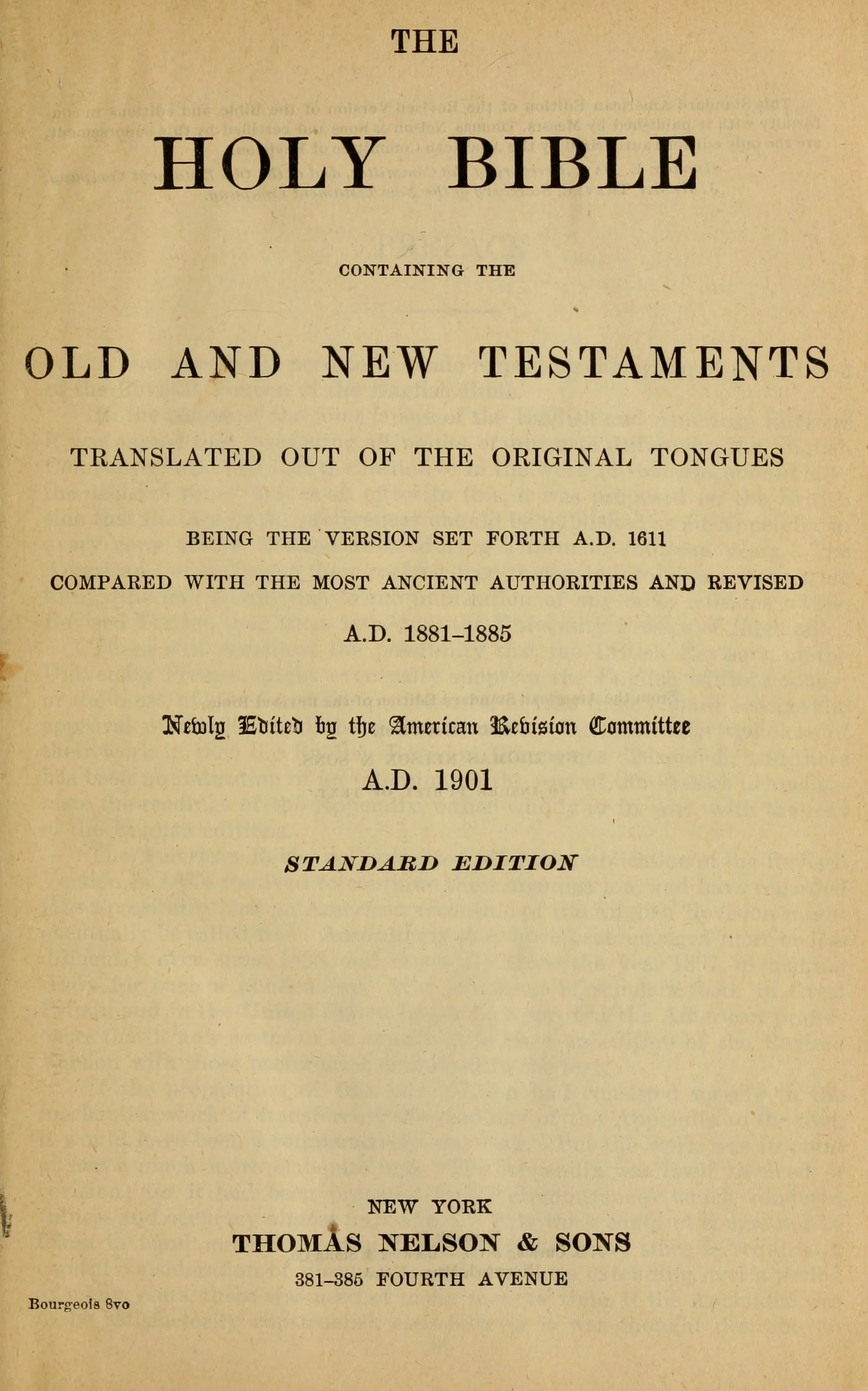
Title page of the American Standard Version Bible, published by Thomas Nelson & Sons, 1901. Public domain. Courtesy of Wikimedia Commons (digitized from the Internet Archive).
One of the most influential English Bible translations of the twentieth century was the American Standard Version (ASV), published on August 27, 1901. The ASV grew out of the English Revised Version (1881), which was the first major revision of the King James Version since its publication in 1611. American scholars who had participated in the revision process believed that some of their preferred readings had not been fully incorporated into the British edition. Their work was therefore published separately as the American Standard Version by Thomas Nelson & Sons.
The ASV was known for its commitment to a highly literal translation philosophy and for incorporating advances in biblical scholarship based on older Hebrew and Greek manuscripts. It also consistently rendered the divine name represented by the Hebrew Tetragrammaton as "Jehovah" in the Old Testament, a distinctive feature that set it apart from many other English translations.
Why It Matters
The American Standard Version became one of the most respected English Bible translations of its era and served as the foundation for several later translations, including the Revised Standard Version (1952), the New American Standard Bible (1971), and the Recovery Version. While its formal style limited its popularity among general readers, its emphasis on textual accuracy made it highly influential among pastors, scholars, and Bible translators throughout the twentieth century.