
August 15, 347 - The Donatist Schism Begins to End
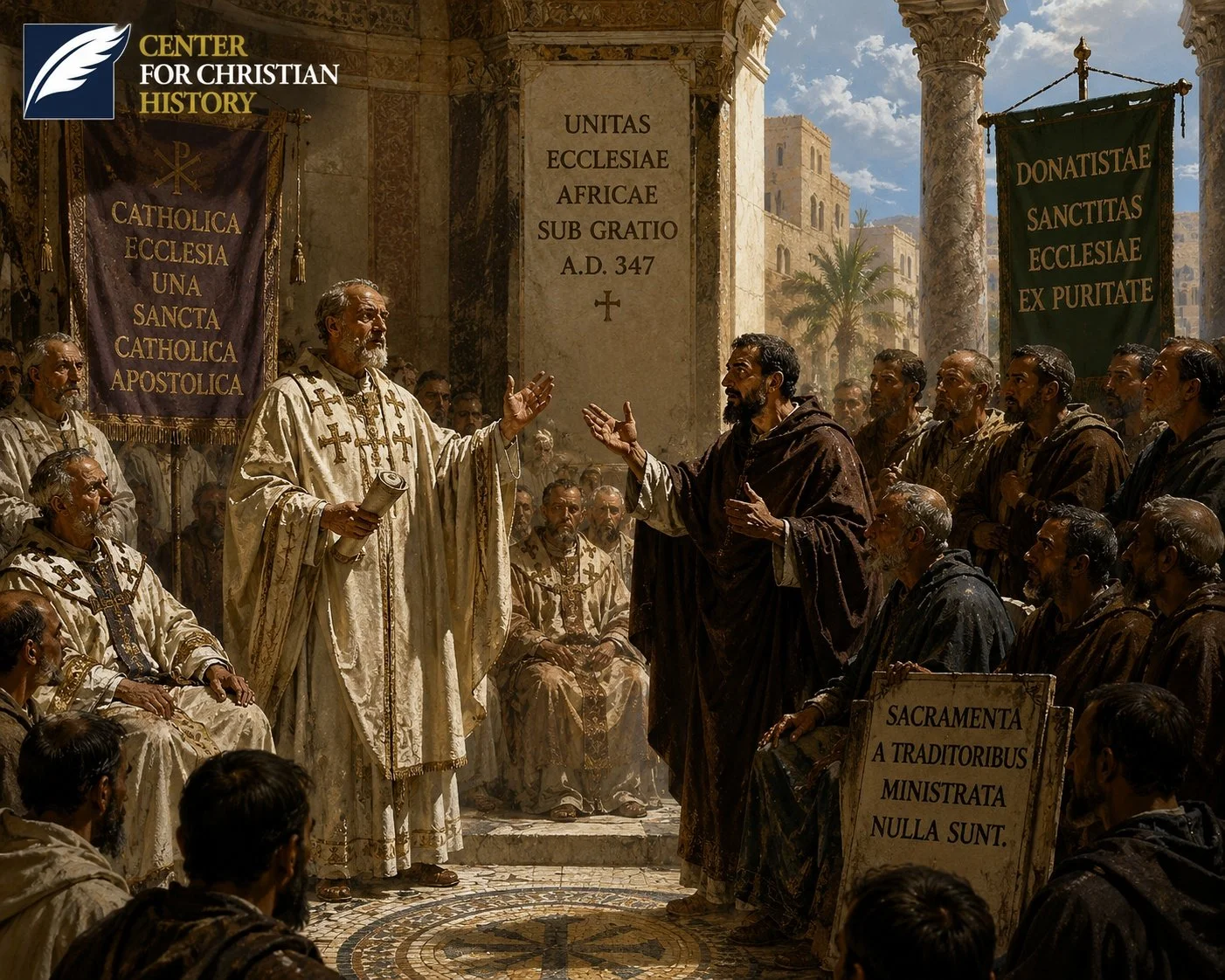
AI-generated historical reconstruction of the Donatist controversy in North Africa (A.D. 347), created for the Center for Christian History. Generated using OpenAI image generation based on historical sources. Used for educational purposes only.
For decades, the churches of North Africa were divided by one of the earliest and most significant controversies in Christian history. Following the Roman persecutions under Emperor Diocletian, some Christians had renounced their faith or surrendered copies of the Scriptures to avoid execution. When the persecutions ended, a group known as the Donatists insisted that these believers—and especially clergy who had compromised—could never be restored to church leadership.
The Donatists believed the Church should consist only of faithful, morally pure Christians. They argued that bishops and priests who had failed during persecution could no longer administer valid baptisms, communion, or other sacraments. The broader Church rejected this teaching, maintaining that the effectiveness of the sacraments depended on Christ rather than on the personal holiness of the minister. This principle would later be defended most famously by Augustine of Hippo.
On August 15, A.D. 347, the Roman proconsul of Africa declared the Catholic Church under Bishop Gratus to be the legitimate church throughout North Africa, bringing official support to the Catholic position after years of conflict. Donatus, the movement's leading figure, withdrew into exile. Although Donatist congregations continued to exist for nearly two centuries, this proclamation marked a significant turning point in the effort to restore unity to the African Church.
Why It Matters
The Donatist controversy forced the early Church to answer a fundamental question: Does God's work depend on the perfection of His servants? The Church concluded that while Christians are called to holiness, God's grace is not limited by human failure. That conviction continues to shape Christian teaching on the Church, the sacraments, forgiveness, and restoration to this day.