
September 21, 1944 - National Religious Broadcasters Established
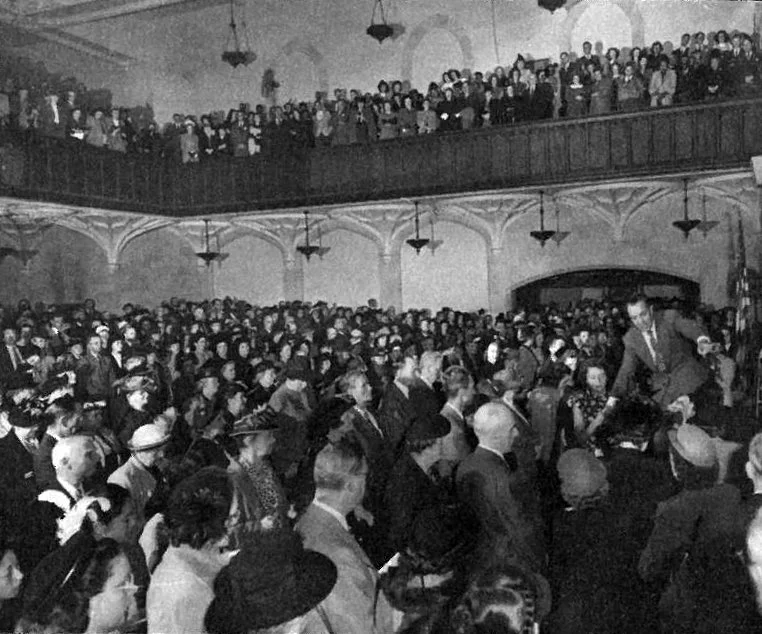
William Ward Ayer (far right), first president of National Religious Broadcasters, conducts an altar call at Calvary Baptist Church in New York City during a live radio broadcast. Photograph reproduced in Mark Ward Sr., Air of Salvation: The Story of Christian Broadcasting (1994). Wikimedia Commons, free-use permission verified through VRT.
By the early 1940s, evangelical Christian broadcasters faced a serious problem: the major American radio networks were increasingly restricting their access to the airwaves. Independent ministries that had spent years building national audiences suddenly found themselves threatened by broadcasting policies that favored established denominational organizations. Their response led to the creation of National Religious Broadcasters (NRB), which was formally established in Chicago on September 21, 1944.
Radio had transformed American communication during the preceding two decades. By the 1930s, millions of Americans gathered around their radios for news, entertainment, music, and religious programming. Christian ministers quickly recognized that broadcasting could carry their sermons far beyond the walls of their churches.
Among the pioneers were Paul Rader, whose broadcasts originated in Chicago; Walter A. Maier, whose Lutheran Hour began in 1930; Theodore Epp, who launched Back to the Bible in 1939; and Charles E. Fuller, whose Old Fashioned Revival Hour became one of America's most widely heard religious programs.
These broadcasters demonstrated that religious programming could attract substantial audiences. However, the rapid expansion of Christian radio also exposed a significant disagreement within American Protestantism.
The major national radio networks, including NBC and CBS, increasingly preferred to provide free broadcasting time to recognized religious organizations rather than sell airtime to individual ministries. This arrangement was known as sustaining time.
For Protestant programming, the networks frequently relied upon the Federal Council of Churches, an organization representing numerous established Protestant denominations. The council favored programming that represented a broad range of participating churches rather than the distinctive theological positions of individual evangelists.
Independent evangelical broadcasters operated differently. They often emphasized personal conversion, biblical authority, and the proclamation of the Gospel. Many were willing to purchase their own airtime, supported by donations from listeners, rather than depend upon the networks' selection of religious representatives.
The disagreement was therefore both theological and institutional. It concerned the content of religious programming, the accountability of broadcasters, and the question of who should determine which Christian voices could reach a national audience.
By 1943, the situation had become particularly serious. The Federal Council of Churches supported proposed broadcasting restrictions that would have further limited independent evangelical programming. The major networks adopted policies restricting the sale of airtime for religious broadcasts, threatening the national reach of ministries that had spent years developing their audiences.
Evangelical broadcasters concluded that individual ministries could not effectively address the problem alone. They needed an organization capable of representing their common interests before the networks, government regulators, and the broader broadcasting industry.
The National Association of Evangelicals, established in 1942, helped provide the organizational framework for that response.
On April 12, 1944, approximately 150 Christian broadcasters and church leaders gathered in Columbus, Ohio, during the National Association of Evangelicals' second annual convention. They organized National Religious Broadcasters as an association dedicated to protecting and expanding evangelical access to radio.
William Ward Ayer, pastor of Calvary Baptist Church in New York City and an experienced radio preacher, was selected as temporary chairman. Dale Crowley served as temporary secretary.
The organization then began preparing the governing documents necessary to establish a permanent association.
Five months later, on September 21, delegates assembled at Moody Memorial Church in Chicago for NRB's constitutional convention. James DeForest Murch, associated with The Christian Hour, headed the committee responsible for preparing the proposed constitution.
According to historian Mark Ward Sr., Moody Bible Institute president Wil Houghton, who was serving as the gathering's unofficial host, encouraged the delegates to begin their proceedings with prayer.
The convention subsequently adopted the constitution and formally incorporated National Religious Broadcasters.
Its founding objectives included improving the professional credibility of evangelical broadcasting, establishing ethical standards, securing access to available public-service broadcasting time, and reversing network restrictions on the purchase of religious airtime.
The organization also adopted a statement of faith that established its evangelical Christian identity while allowing participating broadcasters to retain their individual denominational and ministry affiliations.
NRB's founding represented a significant development in American evangelicalism. Independent ministries that had previously competed for listeners and financial support now possessed a common organization through which they could address shared institutional concerns.
Their efforts produced results within a few years.
In 1949, the relatively new ABC radio network reversed its restrictions on paid religious broadcasting. Other national networks subsequently followed, allowing evangelical ministries to purchase airtime and expand their audiences.
This development helped establish the financial and organizational model that would characterize much of American religious broadcasting during the second half of the twentieth century.
As television expanded, evangelical ministries adopted the new medium. Religious broadcasting eventually grew to encompass nationally distributed television programs, satellite networks, Christian radio stations, and other forms of electronic communication.
NRB expanded alongside those developments, becoming an association of Christian media organizations and professionals involved in broadcasting, publishing, filmmaking, digital communications, and related industries.
Its annual conventions also became gathering places for Christian communicators, providing opportunities for professional training, industry networking, and discussion of issues affecting religious media.
Although the technologies have changed considerably since 1944, the organization's original concern with access to mass communication remains central to its institutional identity.
Why It Matters
The formal establishment of National Religious Broadcasters on September 21, 1944, gave independent evangelical broadcasters an organized voice in an industry where access to national audiences was increasingly controlled by major networks. Its efforts contributed to the expansion of paid religious broadcasting and helped establish a model subsequently adopted by numerous Christian radio and television ministries. The organization illustrates how twentieth-century evangelical Christianity developed new institutions to participate in America's rapidly changing mass-media environment.
