
September 23, 1122 - Concordat of Worms
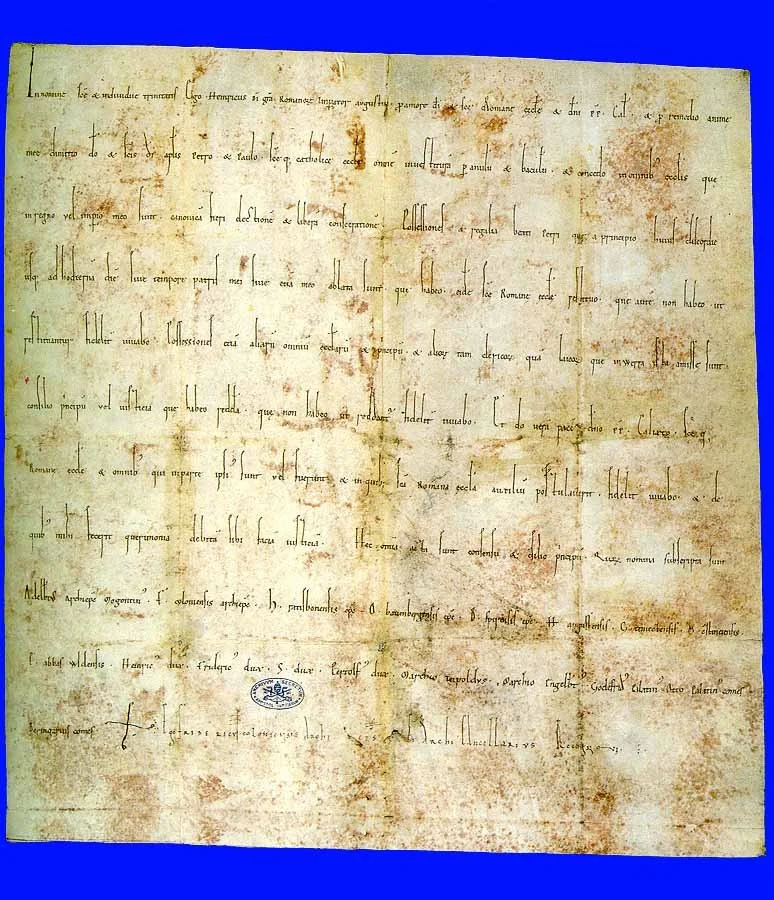
Concordat of Worms, imperial document of Henry V, September 23, 1122. Wikimedia Commons, Public Domain.
Who had the authority to appoint a bishop—the pope or the emperor? For much of the Middle Ages, this question was about far more than religious leadership. Bishops controlled extensive lands, collected revenues, administered justice, and sometimes commanded military forces. Whoever appointed them could exercise considerable influence over both the church and the political affairs of Europe.
The struggle over this authority became known as the Investiture Controversy, one of the most consequential conflicts between the medieval papacy and the Holy Roman Empire. It formally ended on September 23, 1122, when representatives of Pope Calixtus II and Holy Roman Emperor Henry V reached an agreement in Worms, Germany, known as the Concordat of Worms.
To understand the controversy, it is important to recognize that the medieval church operated within a political system in which religious and governmental responsibilities frequently overlapped. The Holy Roman Empire encompassed much of modern Germany and surrounding territories, where bishops often governed substantial territories and possessed privileges similar to those of secular princes.
For generations, emperors had exercised considerable influence over the appointment of bishops and abbots. An emperor could select a trusted individual to occupy an important bishopric and formally invest him with the symbols of his religious office, including a ring and pastoral staff. This practice helped rulers maintain political influence throughout their territories while placing loyal supporters in powerful ecclesiastical positions.
During the eleventh century, church reformers increasingly challenged this arrangement. They argued that secular rulers should not possess the authority to determine who occupied spiritual offices. Their concerns included simony, the buying and selling of ecclesiastical positions, and the possibility that political loyalty rather than religious qualifications would determine who became a bishop.
The controversy intensified under Pope Gregory VII, who became pope in 1073. Gregory insisted that the authority to appoint and invest bishops belonged to the church rather than secular rulers. His position brought him into direct confrontation with Holy Roman Emperor Henry IV.
In 1076, Henry challenged Gregory’s authority and supported efforts to remove him from the papacy. Gregory responded by excommunicating Henry and declaring that his subjects were released from their obligations of loyalty to him. German nobles subsequently used the controversy to challenge Henry’s rule.
Facing a serious political crisis, Henry traveled to Canossa in northern Italy in January 1077, where Gregory was staying at a castle. Henry performed public penance and sought absolution from the pope. Gregory eventually lifted the excommunication, but the reconciliation did not resolve the underlying disagreement.
The struggle continued through military campaigns, competing claims to authority, and additional excommunications. Henry eventually supported a rival claimant to the papacy, Clement III, who crowned him emperor in Rome in 1084.
When Henry V succeeded his father in 1106, he inherited the unresolved controversy. Although he had initially supported the church reform movement against Henry IV, he soon confronted the same political dilemma. Surrendering control over episcopal appointments threatened an important source of imperial authority.
In 1111, Henry V attempted to negotiate a settlement with Pope Paschal II. One proposal would have required bishops to surrender their secular possessions and governmental privileges in exchange for freedom from imperial control over their spiritual offices. The arrangement proved unacceptable to many bishops, whose institutions depended upon those lands and revenues.
Henry subsequently detained Paschal and secured concessions permitting imperial investiture. However, church reformers rejected the settlement, and the controversy continued.
The eventual agreement came under Pope Calixtus II, who became pope in 1119 and pursued negotiations with the emperor. These efforts culminated in the Concordat of Worms on September 23, 1122.
Under the agreement, Henry V renounced the practice of investing bishops and abbots with the ring and pastoral staff, acknowledging that these symbols represented spiritual authority belonging to the church. Bishops were to be selected through elections conducted according to church law and consecrated by ecclesiastical authorities.
However, the emperor retained important political privileges. In the German kingdom, episcopal elections could occur in his presence, and he could participate in resolving disputed elections under the agreement’s provisions. Bishops also continued to receive their secular rights and possessions from the emperor through a separate ceremony involving a scepter.
The agreement therefore distinguished between a bishop’s spiritual authority and the political privileges attached to his position. A bishop could receive religious authority through the church while continuing to exercise governmental responsibilities under imperial authority.
The Concordat was subsequently confirmed at the First Lateran Council in 1123, convened by Calixtus II in Rome. The council also addressed additional matters of church reform, helping establish the settlement within the institutional life of medieval Christianity.
Although the agreement did not establish the modern separation of church and state, it provided an important framework for distinguishing religious authority from secular power. Popes and emperors continued to influence one another, but the Concordat of Worms established a negotiated settlement that shaped their relationship for generations.
Why It Matters
The Concordat of Worms formally ended the principal phase of the Investiture Controversy and established a lasting framework for relations between the papacy and the Holy Roman Empire. By distinguishing spiritual investiture from the granting of secular privileges, it helped define the respective authority of church leaders and political rulers in medieval Europe. Its provisions influenced ecclesiastical appointments and church-state relations for generations.
