
September 26, 1626 - Bishop Lancelot Andrewes Dies
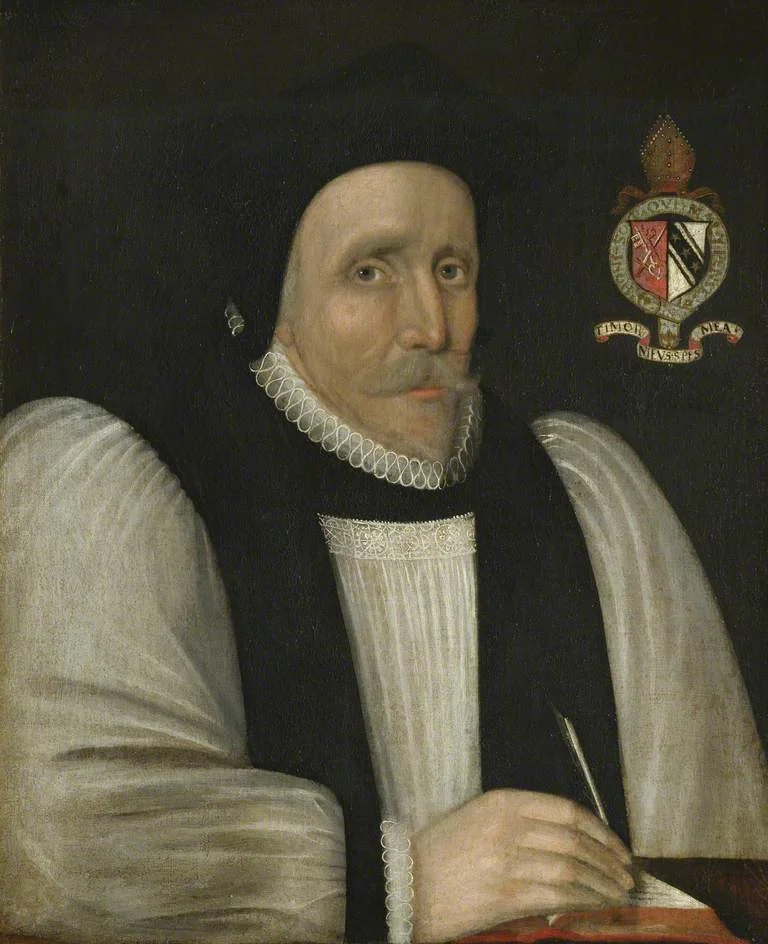
Lancelot Andrewes (1555–1626). Artist unknown. Oil on canvas. Pembroke College, University of Cambridge. Public Domain. Image via Wikimedia Commons.
Few English churchmen of the late sixteenth and early seventeenth centuries combined biblical scholarship, preaching, and royal influence as successfully as Lancelot Andrewes. Serving under Queen Elizabeth I, King James I, and King Charles I, Andrewes became one of the Church of England’s most respected theologians. His accomplishments included serving as a royal chaplain, leading one of England’s most prominent colleges, holding three bishoprics, and directing an important portion of the translation project that produced the King James Bible. He died on September 26, 1626, leaving a legacy that extended well beyond the English church.
Born in London in 1555, Andrewes received his early education at Merchant Taylors’ School before entering Pembroke Hall at Cambridge University. His academic abilities quickly distinguished him, particularly his mastery of biblical languages and early Christian literature. He eventually became a fellow of Pembroke and, in 1589, its master, a position he held until 1605.
Andrewes entered the ministry during a period of significant religious tension in England. Elizabeth I had restored Protestantism following the reign of her Catholic predecessor, Mary I, but disagreements continued over how thoroughly the Church of England should separate itself from Roman Catholic practices. Puritans advocated further reforms, while other church leaders defended the established structure of bishops, liturgy, and royal authority.
Andrewes generally supported the established Church of England, although his theological positions did not always align neatly with those of his contemporaries. His scholarship, preaching, and administrative abilities brought him to the attention of Elizabeth I, who appointed him a royal chaplain. He subsequently held several prominent ecclesiastical positions, including canon of Westminster and dean of Westminster Abbey.
When James VI of Scotland inherited the English throne as James I in 1603, Andrewes continued to enjoy royal favor.
One of the new king’s earliest challenges involved religious disagreements within the Church of England. Puritan ministers had presented the Millenary Petition, requesting changes in church government and worship. James responded by convening the Hampton Court Conference in January 1604, bringing together leading bishops and Puritan representatives to discuss their concerns.
The conference did not produce the extensive reforms sought by the Puritans, but it resulted in one of the most consequential publishing projects in English Christian history.
During the discussions, Puritan scholar John Rainolds proposed a new English translation of the Bible. James approved the proposal, and arrangements began for a translation prepared by teams of scholars working from the biblical languages.
Andrewes participated in the Hampton Court Conference and subsequently received a leading role in the translation project. Importantly, he did not direct the conference itself, which was chaired by King James.
The translation effort was divided among six companies of scholars working at Westminster, Oxford, and Cambridge. Andrewes directed the First Westminster Company, responsible for Genesis through 2 Kings. This assignment included the Pentateuch, the first five books of the Old Testament, along with several of Israel’s historical books.
The scholars did not begin with a blank page. They consulted earlier English translations, including the Bishops’ Bible, as well as Hebrew and Greek manuscripts and other scholarly resources. The objective was to produce an English Bible suitable for public worship and acceptable to the established church.
Andrewes’s extensive knowledge of biblical languages made him particularly suited to the work. His company’s translations underwent review alongside the contributions of the other companies before the completed Bible appeared in 1611.
The resulting King James Version, also known as the Authorized Version, gradually became the dominant English Bible in many Protestant churches. Its influence extended into literature, education, public speaking, and everyday English expressions.
Although Andrewes is frequently remembered for his contribution to the King James Bible, his ecclesiastical career continued to advance.
In 1605, he became Bishop of Chichester. He was subsequently appointed Bishop of Ely in 1609 and Bishop of Winchester in 1619. The Winchester appointment placed him among the most prominent bishops in England.
He also served on the Privy Council, participated in the religious affairs of the monarchy, and became known for sermons delivered before the royal court. His preaching combined careful examination of Scripture with extensive knowledge of theology and the writings of the early church.
Andrewes’s influence, however, was not limited to public ministry.
His private spiritual writings eventually became one of the most enduring parts of his literary legacy. During his lifetime, he composed prayers and meditations for personal use, frequently writing in Greek and Latin rather than English.
These writings were published after his death in collections commonly known as Private Devotions or Preces Privatae. An English edition appeared in 1647, followed by another translation in 1648. Subsequent editions introduced his prayers to generations of Anglican and other Christian readers.
Andrewes died at Winchester House in Southwark, London, and was buried in St. Saviour’s Church, now Southwark Cathedral. His tomb remains there today.
Why It Matters
Lancelot Andrewes helped shape the religious and intellectual life of the Church of England during the transition from the Elizabethan to the Stuart monarchy. His leadership of the First Westminster Company connected him directly to the production of the 1611 King James Bible, while his sermons and private prayers continued to influence Anglican theology and worship long after his death.
