
September 28, 1808 - Andover Seminary Holds Formal Opening
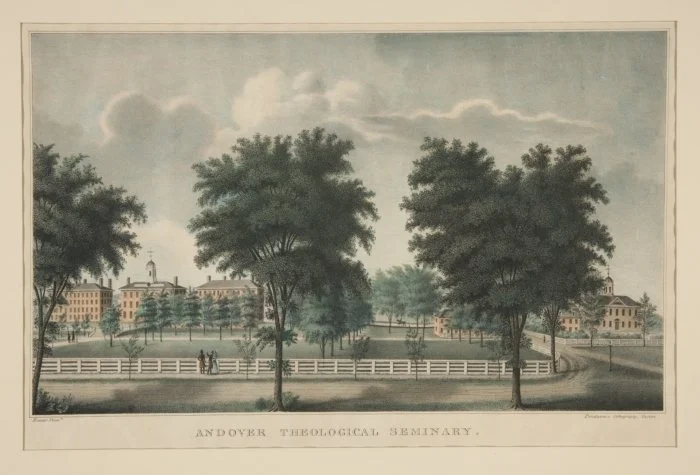
Andover Theological Seminary, Andover, Massachusetts. Historic lithograph by J. Kidder. Courtesy of Yale University Art Gallery. Public Domain, via Wikimedia Commons.
The founding of America’s first graduate-level theological seminary grew out of a dispute over the direction of Christian theology at Harvard University. On September 28, 1808, Andover Theological Seminary formally opened in Andover, Massachusetts, establishing a new model for educating Protestant ministers that would influence American theological education for generations.
The story began with a growing division among New England Congregationalists. During the eighteenth century, Congregational churches had been shaped by the Calvinist theology of the Puritans and the evangelical revival associated with the First Great Awakening. By the early nineteenth century, however, theological disagreements had emerged over the authority of Scripture, human nature, salvation, and the doctrine of the Trinity.
Harvard, originally established in 1636 to educate ministers for the Massachusetts Bay Colony, became a central battleground in this controversy.
Traditional Calvinists believed that Harvard was moving away from the theological convictions of its founders. Their concerns intensified in 1805 when Harvard appointed Henry Ware to the prestigious Hollis Professorship of Divinity. Ware was associated with the liberal theological movement that would become increasingly identified with Unitarianism, which rejected the traditional Christian doctrine of the Trinity.
For orthodox Congregationalists, the appointment raised a practical question: Where would they educate future ministers who shared their theological convictions?
Their answer was to establish a new institution.
The founders selected Andover, Massachusetts, where Phillips Academy had operated since 1778. The academy had been established through the generosity of the Phillips family, whose commitment to education and Christian faith made the campus a suitable home for the proposed seminary.
The Massachusetts legislature authorized the institution in 1807, and its founders spent the following year organizing its faculty, finances, curriculum, and theological commitments.
The seminary also represented a compromise between two groups of Calvinists who disagreed over certain theological questions. Traditional Calvinists and followers of the theological movement associated with Jonathan Edwards and Samuel Hopkins agreed to cooperate in establishing an institution committed to their shared evangelical convictions.
The resulting theological standards reflected this effort to preserve Calvinist orthodoxy while accommodating differences within the tradition.
On September 28, 1808, the seminary held its formal opening exercises. Timothy Dwight, president of Yale College and an influential Congregational minister, delivered the inaugural sermon. The occasion also included the ordination of Eliphalet Pearson, who became one of the institution’s first professors.
Leonard Woods, an important figure in the founding controversy, became the seminary’s first professor of Christian theology.
Andover introduced a significant innovation in American education.
Previously, most aspiring Protestant ministers attended an undergraduate college before completing their theological preparation through private study under an experienced clergyman. Although theological instruction was available at several colleges, there was no established American graduate institution devoted exclusively to preparing ministers.
Andover offered a more systematic approach.
Its three-year program emphasized biblical studies, Christian theology, church history, and the practical responsibilities of ministry. Students studied the biblical languages, examined Christian doctrine, and received instruction in preaching and pastoral work.
The seminary's influence extended well beyond New England.
During the early nineteenth century, American Protestant churches began organizing foreign missionary societies on a much larger scale. The American Board of Commissioners for Foreign Missions, established in 1810, developed close connections with Andover and drew many of its early missionaries from the institution.
Among its graduates were Hiram Bingham and Asa Thurston, who traveled to the Hawaiian Islands in 1820 as members of the first company of missionaries sent there by the American Board.
Other Andover graduates participated in missionary work across Asia, the Middle East, and other regions.
The institution also contributed to American religious scholarship through its faculty, graduates, publications, and extensive theological library.
Yet the seminary’s own theological identity would change over time.
During the nineteenth century, its professors and administrators encountered many of the same intellectual and theological developments that had contributed to its original separation from Harvard. Debates over biblical interpretation, doctrinal authority, and the relationship between Christianity and modern scholarship eventually produced controversies within Andover itself.
By the early twentieth century, the institution had developed a substantially different relationship with Harvard.
In 1908, exactly one century after its opening, Andover relocated to Cambridge and began an affiliation with Harvard Divinity School. The arrangement brought the two institutions into closer academic cooperation, although efforts toward a permanent institutional union encountered legal difficulties.
Andover subsequently relocated to Newton, Massachusetts, in 1931, where it shared a campus with Newton Theological Institution, a Baptist seminary founded in 1825.
The two institutions formally merged in 1965 to establish Andover Newton Theological School.
In 2017, Andover Newton began a new chapter through its affiliation with Yale Divinity School in New Haven, Connecticut, where its institutional legacy continues as Andover Newton Seminary.
Why It Matters
Andover Theological Seminary established a model of graduate theological education that influenced the development of Protestant seminaries throughout the United States. Its founding also illustrates how theological disagreements within American Christianity contributed to the creation of new educational institutions, while its graduates helped expand American Protestant missionary activity during the nineteenth century.
