
September 29, 1413 - Sir John Oldcastle Executed
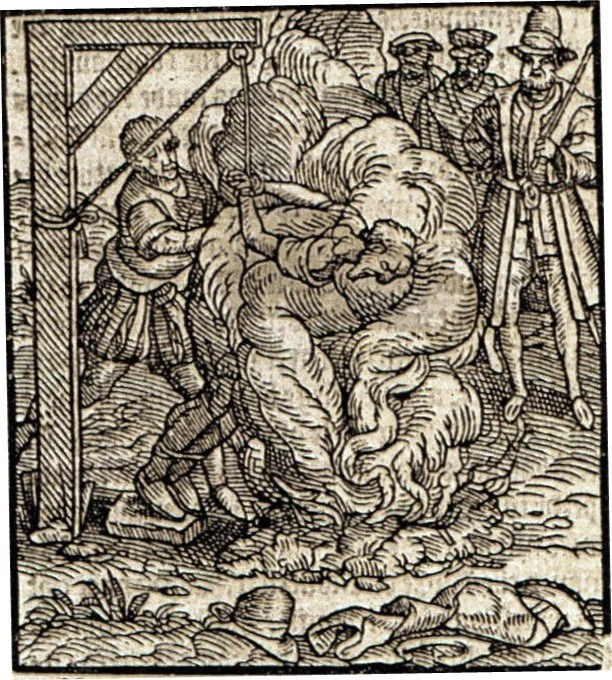
The execution of Sir John Oldcastle, an early supporter of the Lollard movement, in December 1417. Illustration originally published in Holinshed's Chronicles (1577). Wikimedia Commons, public domain.
Sir John Oldcastle was a respected English knight, a member of Parliament, and a personal friend of King Henry V. He was also one of the most prominent supporters of the Lollards, a religious reform movement that challenged the authority and teachings of the medieval Roman Catholic Church. His refusal to abandon those beliefs brought him before Archbishop of Canterbury Thomas Arundel in September 1413, beginning a confrontation that would ultimately cost him his life.
The Lollard movement originated in the teachings of John Wycliffe, an Oxford theologian who died in 1384. Wycliffe argued that Scripture should serve as the supreme authority in Christian belief and practice. He questioned the accumulation of wealth and political power by the clergy, challenged aspects of Catholic sacramental theology, and advocated making the Bible available to ordinary Christians in their own language.
Wycliffe and his followers helped inspire the production and circulation of English Bible translations, allowing people who could not read Latin to encounter Scripture directly. This was particularly controversial because the medieval church exercised considerable authority over biblical interpretation and religious instruction.
Although Wycliffe died decades before Oldcastle's trial, his teachings continued to spread throughout England. His followers, known as Lollards, included preachers, tradesmen, landowners, and members of the English nobility.
Oldcastle was among the movement's most influential supporters.
Born into a landowning family in Herefordshire, Oldcastle established himself through military service and political connections. He represented Herefordshire in Parliament in 1404 and developed a close relationship with the future Henry V while serving in military campaigns.
His marriage to Joan, Lady Cobham, elevated his social position, and he became known as Lord Cobham through his wife's title.
By 1410, Oldcastle was openly associated with Lollard teachings. He supported itinerant preachers, provided protection for religious reformers, and defended positions that church authorities considered heretical.
His prominence presented a particular problem for Archbishop Thomas Arundel, who had spent years attempting to suppress Lollardy.
In 1409, Arundel had issued religious regulations known as the Constitutions of Oxford. These restricted unauthorized preaching, the translation and circulation of Scripture in English, and the teaching of doctrines contrary to the established church.
Oldcastle's continued support for Lollard preachers placed him in direct opposition to the archbishop.
When Henry V became king in March 1413, Oldcastle initially benefited from their longstanding friendship. Henry attempted to persuade him privately to abandon his religious positions, but Oldcastle refused to accept the church's authority on several disputed teachings.
Eventually, the king permitted ecclesiastical proceedings to move forward.
Oldcastle appeared before church authorities on September 23, 1413. His examination concerned several theological questions, including the Eucharist, confession to a priest, religious images, and the authority of the pope and bishops.
Oldcastle affirmed his Christian faith and accepted the importance of the sacraments, but he rejected certain explanations of them required by the church. He also opposed placing religious trust in images and challenged the authority of church leaders to impose teachings he believed lacked scriptural justification.
On September 25, Archbishop Arundel's ecclesiastical court condemned Oldcastle for heresy.
The proceedings surrounding his condemnation continued to be associated with the final days of September, although the surviving trial account identifies September 25, rather than September 29, as the date of his formal conviction.
Henry V granted Oldcastle a temporary reprieve, hoping that his former companion would reconsider his position.
Instead, Oldcastle escaped from the Tower of London in October 1413.
His escape transformed a religious controversy into a political crisis.
In January 1414, a gathering of Lollards at St. Giles's Fields near London was suppressed by royal forces. Authorities accused Oldcastle and his supporters of plotting against Henry V and attempting to overthrow the existing political and religious order.
The precise intentions of everyone involved remain disputed, but the government treated the gathering as an attempted rebellion. Several participants were executed, and the authorities intensified their efforts to suppress Lollardy.
Oldcastle avoided capture and remained a fugitive for nearly four years.
During this period, the English government continued its campaign against suspected Lollards, whose religious dissent was increasingly associated with political disloyalty.
Oldcastle was finally captured in Wales in 1417 and brought back to London.
He was condemned for treason and heresy and executed on December 14, 1417.
His execution was particularly severe. Contemporary and later accounts describe him being suspended in chains while a fire was lit beneath him, combining hanging with burning.
Oldcastle's death did not end the Lollard movement. Its teachings and religious literature continued to circulate in England, despite repeated efforts to suppress them.
More than a century later, the English Reformation renewed many of the questions that Wycliffe, Oldcastle, and other Lollards had raised concerning biblical authority, religious images, clerical power, and access to Scripture in the English language.
Why It Matters
Sir John Oldcastle's trial illustrates the relationship between religious authority and royal power in medieval England. His case also demonstrates how theological dissent could become entangled with accusations of political rebellion. The survival of Lollard teachings helped preserve a tradition of English religious reform that preceded the Protestant Reformation by more than a century.
