
July 16, 1054 - The Great Schism
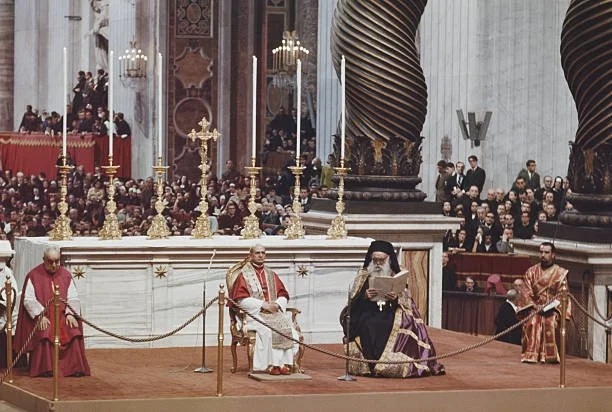
Athenagoras I with Pope Paul VI in Rome (1967). Wikimedia Commons. Public domain (PD-Italy/PD-1996)
On July 16, 1054, one of the most consequential events in Christian history reached its breaking point. After centuries of growing disagreement, representatives of the bishop of Rome and the patriarch of Constantinople formally excommunicated one another, marking what became known as the Great Schism. Although political tensions and theological disputes had been building for generations, this dramatic exchange symbolized the permanent division between the Roman Catholic Church in the West and the Eastern Orthodox Church in the East.
The separation was not caused by a single issue. Differences had accumulated over questions of papal authority, the wording of the Nicene Creed (particularly the Filioque clause), language and worship practices, and the growing cultural divide between the Latin-speaking West and the Greek-speaking East. While later efforts at reconciliation have occurred, the schism remains one of the defining moments in the history of Christianity.
One of the most encouraging moments in that reconciliation came nearly nine centuries later. In 1967, Pope Paul VI and Ecumenical Patriarch Athenagoras I met in Rome during a series of historic visits that demonstrated a renewed commitment to Christian dialogue and mutual respect. Their meetings built upon the lifting of the mutual excommunications in 1965 and marked a significant step toward healing a division that had endured for more than 900 years.
Jesus prayed that His followers "may all be one" (John 17:21), and the Apostle Paul repeatedly urged believers to preserve unity within the body of Christ (Ephesians 4:1–6). Yet church history reminds us that sincere Christians have often disagreed over doctrine, authority, and practice. The Great Schism demonstrates both the importance of theological conviction and the tragic consequences that can result when disagreements become permanent divisions.
Why This Matters
The Great Schism continues to shape Christianity nearly a thousand years later. Today, the Roman Catholic Church and the Eastern Orthodox Church together represent well over a billion Christians worldwide. While important theological differences remain, the meetings between Pope Paul VI and Patriarch Athenagoras remind us that Christians can pursue truth with conviction while also seeking reconciliation, mutual understanding, and the unity for which Christ prayed.
